As I sit here tucked into a marina on the other side of the world, ready to celebrate New Years Eve almost a full day ahead of our friends and family, I can’t help but think what an amazing year 2024 has been. We have been to so many amazing places, while facing big challenges. In 2024, we sailed roughly 9000 miles, starting with some further exploration of Mexico before crossing the Pacific Ocean to explore French Polynesia, Tonga and now Fiji.
When we started making this big plan to go sailing years ago, we had a direct plan as far as Mexico – the rest – an ocean crossing and exploring distant islands – really seemed so far out of reach it didn’t seem real. Somehow, we did make it real.
The following is a brief recap of the highlights of 2024.
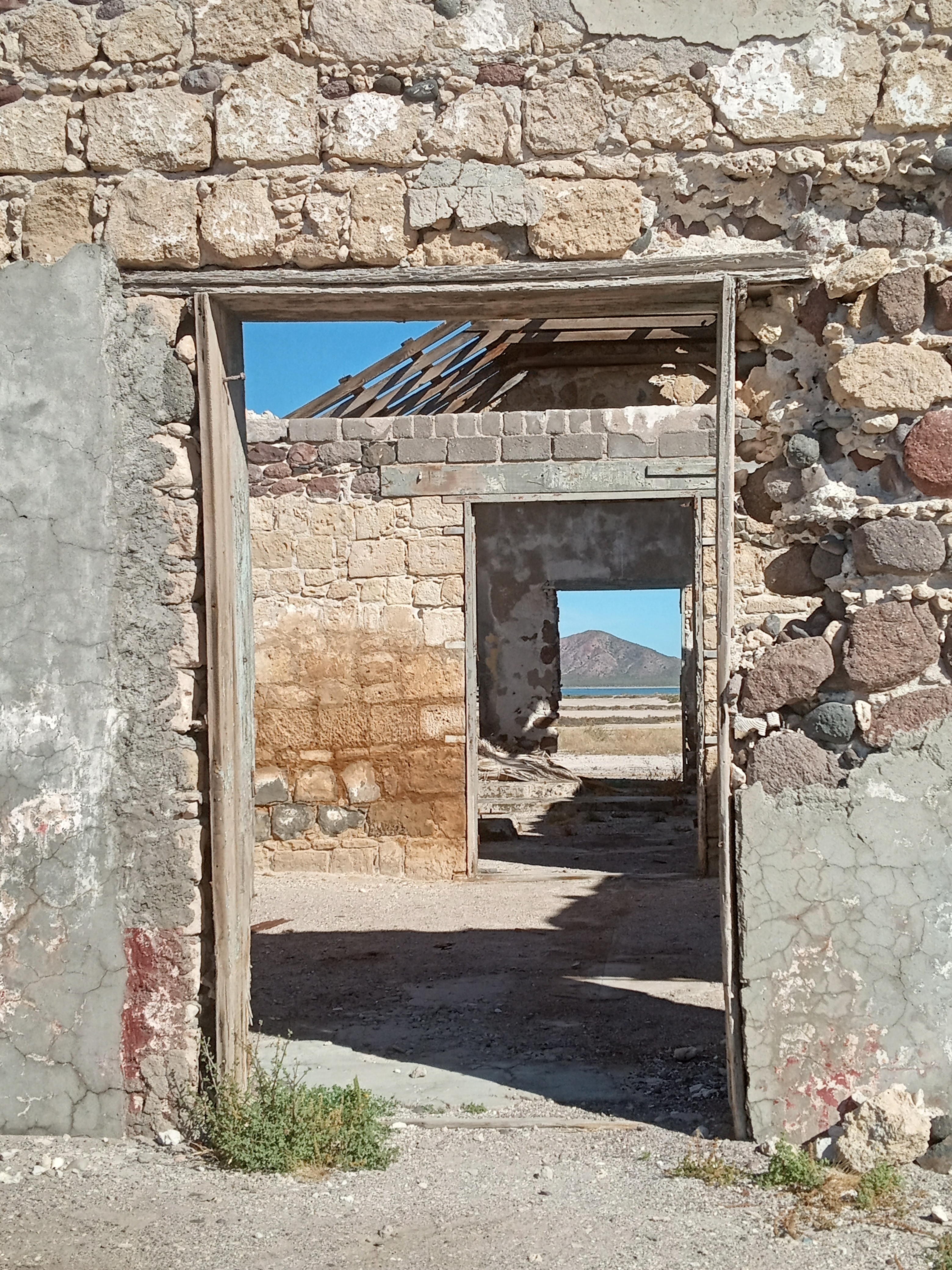
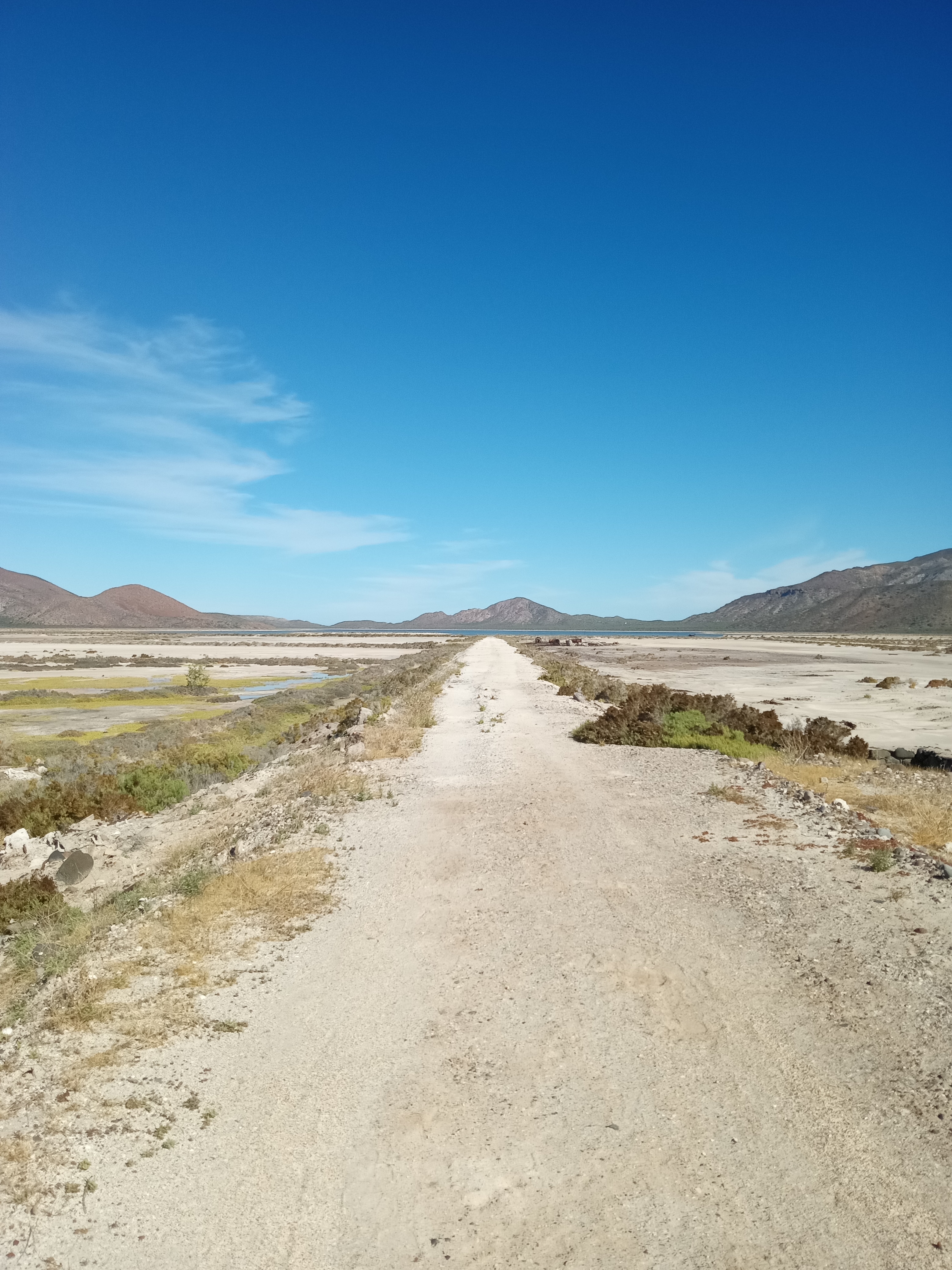
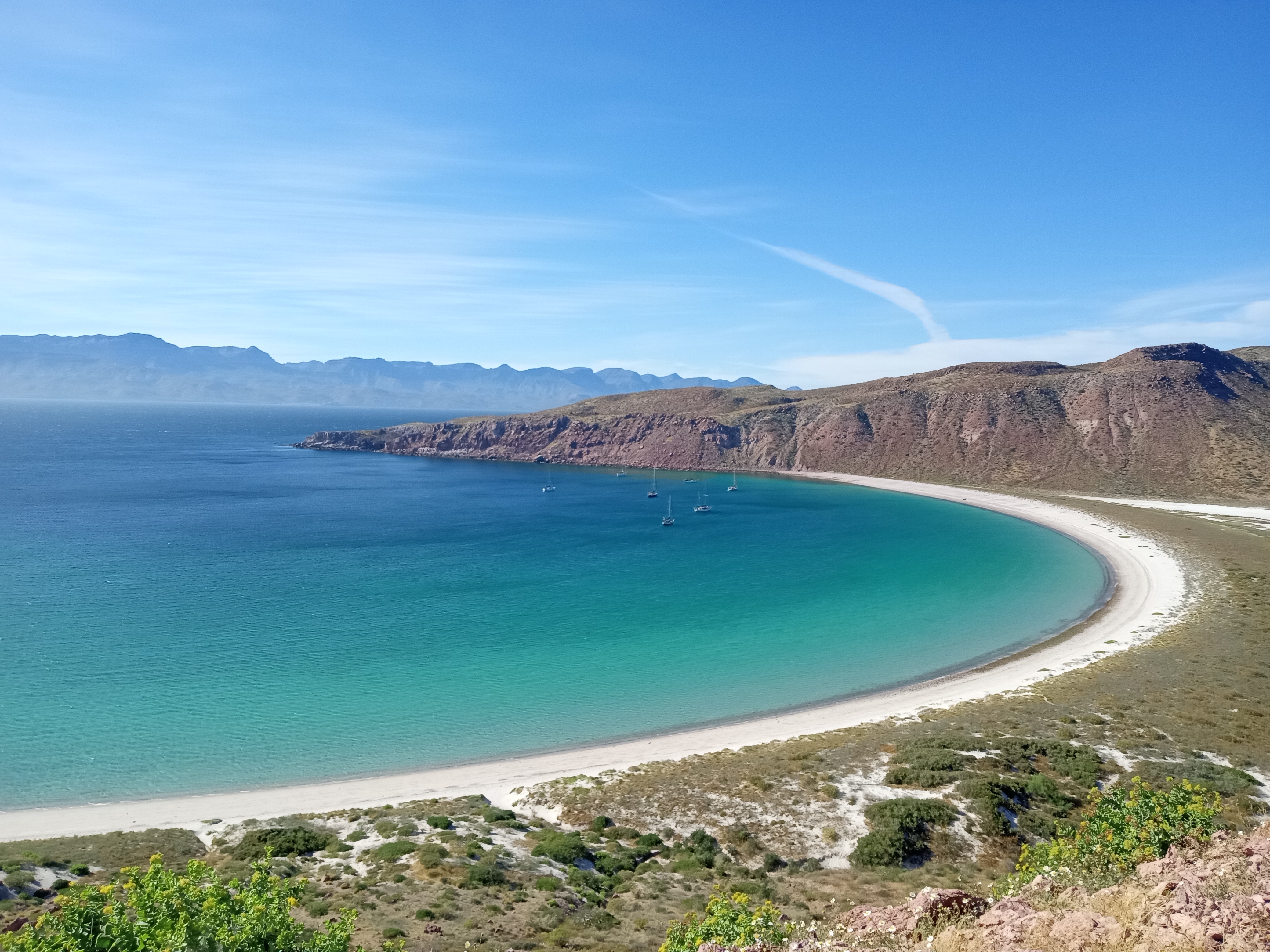
1. Cruising the Baja – we started this year by cruising down the Baja peninsula, after nearly 3 months in the boat yard in Puerto Penasco. Truly, being free of the yard was a gift in of itself, but our favorite stops on the way down the peninsula this time were probably Santa Rosalia, Isla Coronado and Isla San Francisco. Having already explored Santa Rosalia on our way up the peninsula last year, we still managed to find lots of new spots to explore and enjoyed our time getting back into the cruising mentality. Isla San Francisco gave us the opportunity for some hiking and some visiting and Isla Coronado gave us some excellent anchorages and the chance to explore an abandoned salt mine. While it wasn’t always warm in winter on the Baja, the ever-changing beauty makes it some of our favorite cruising.
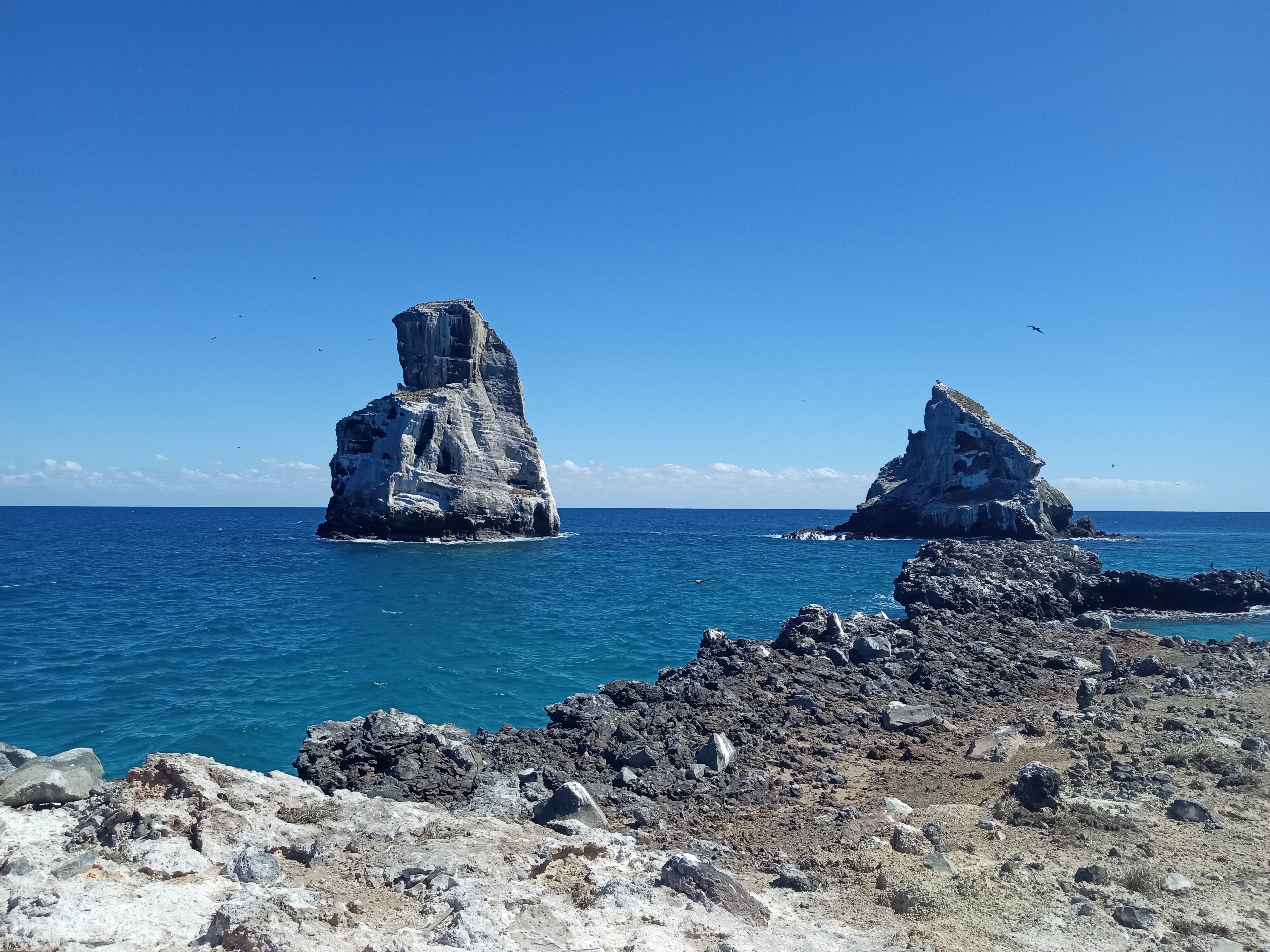
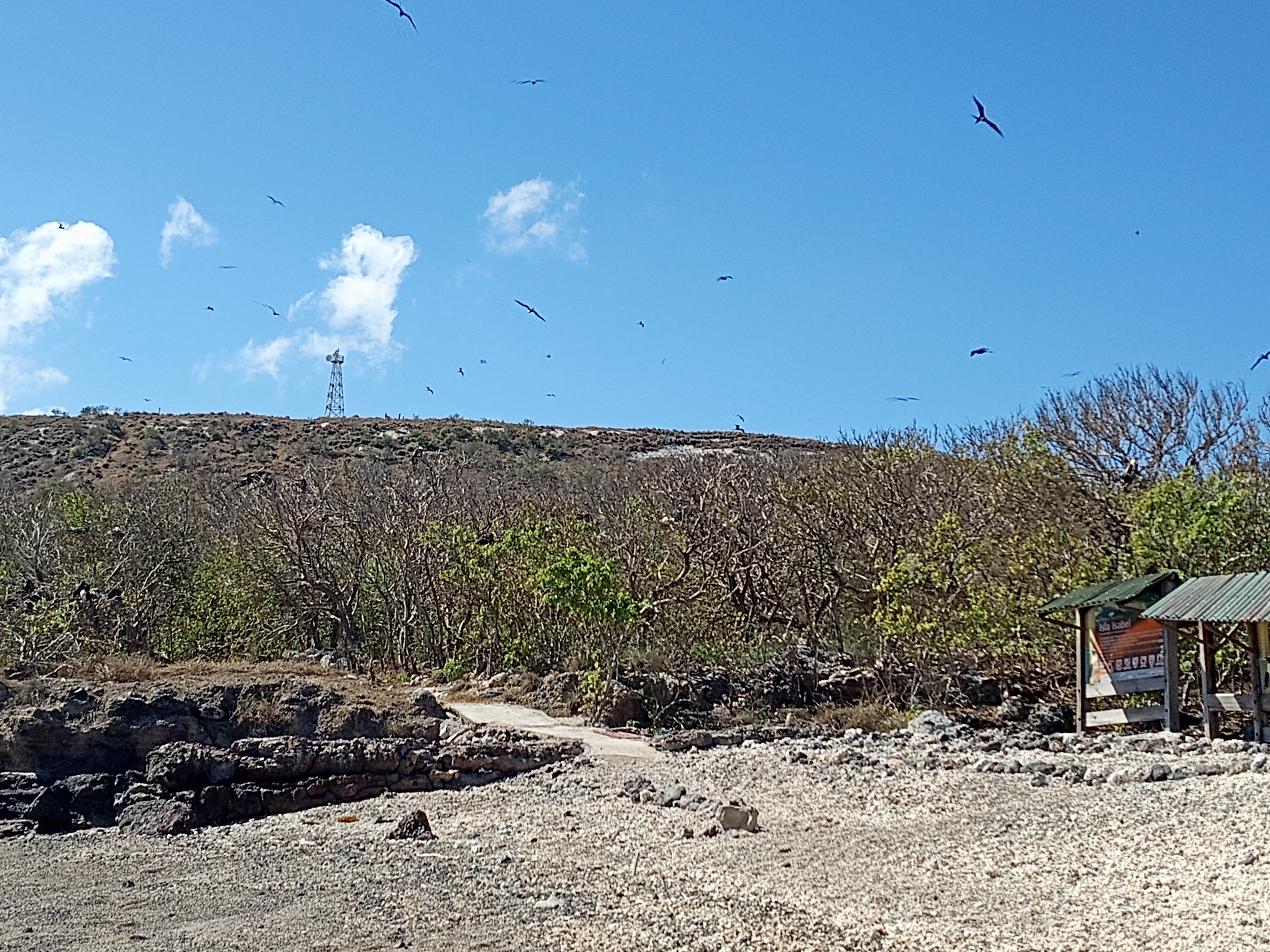
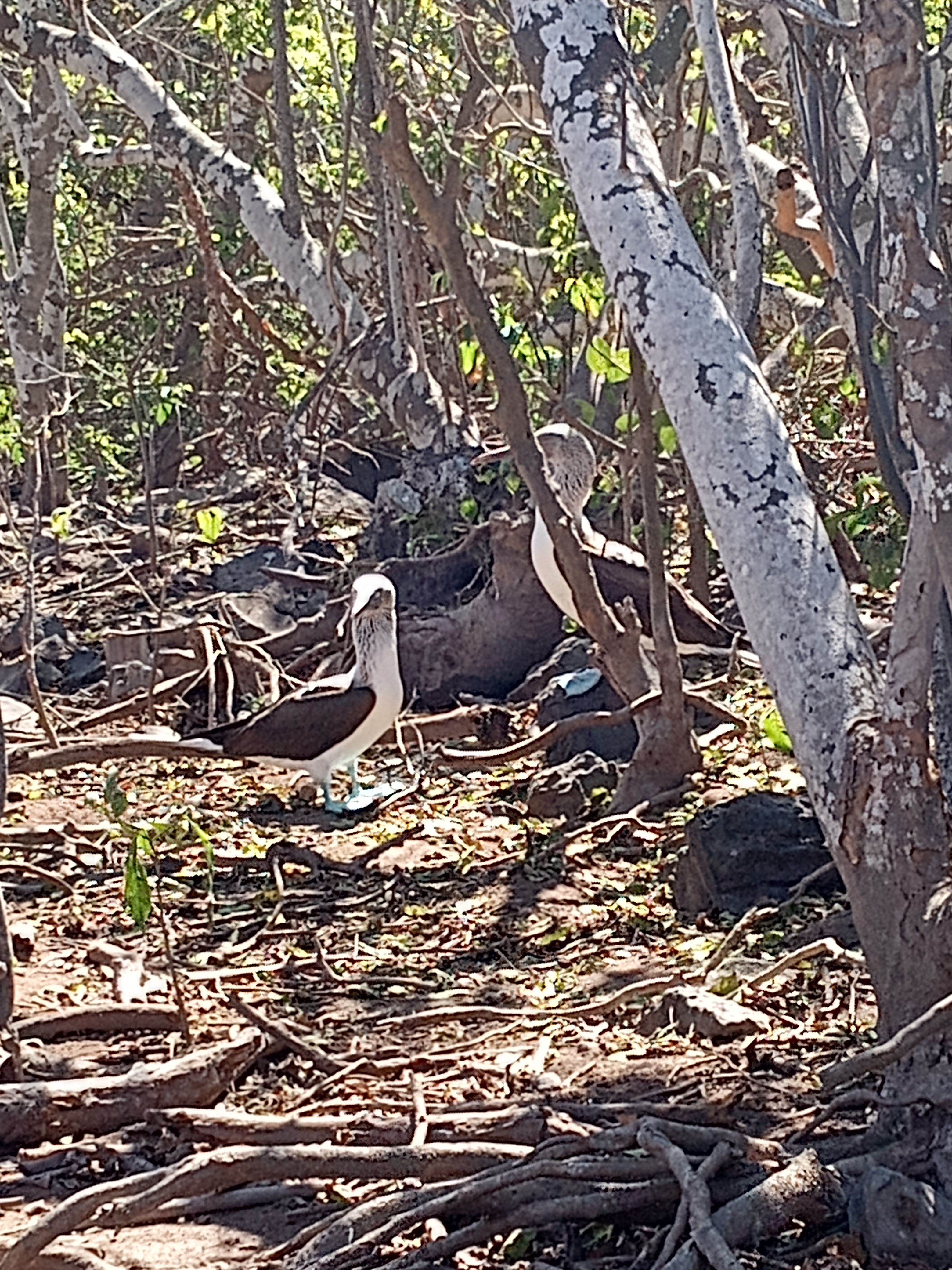
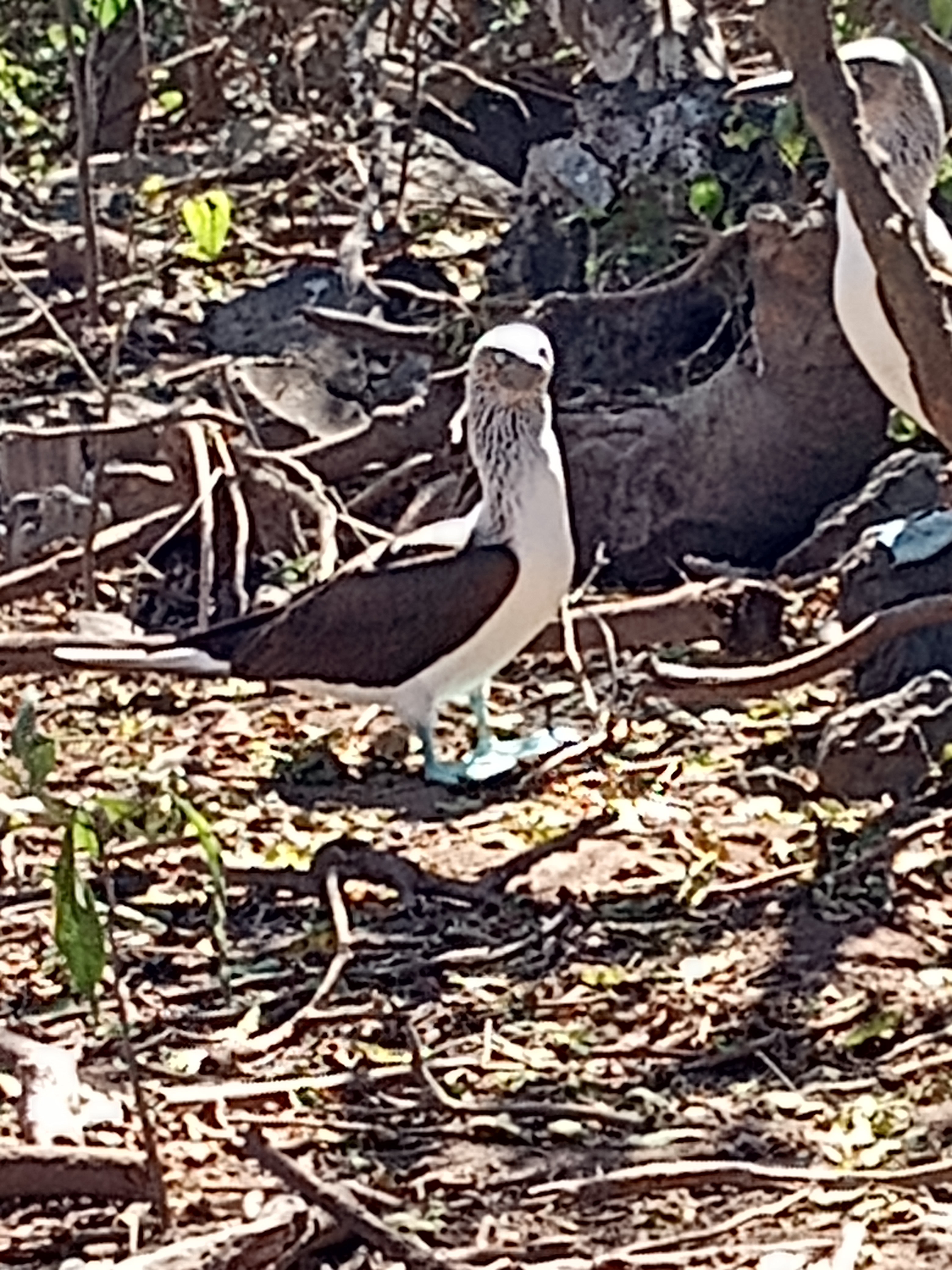
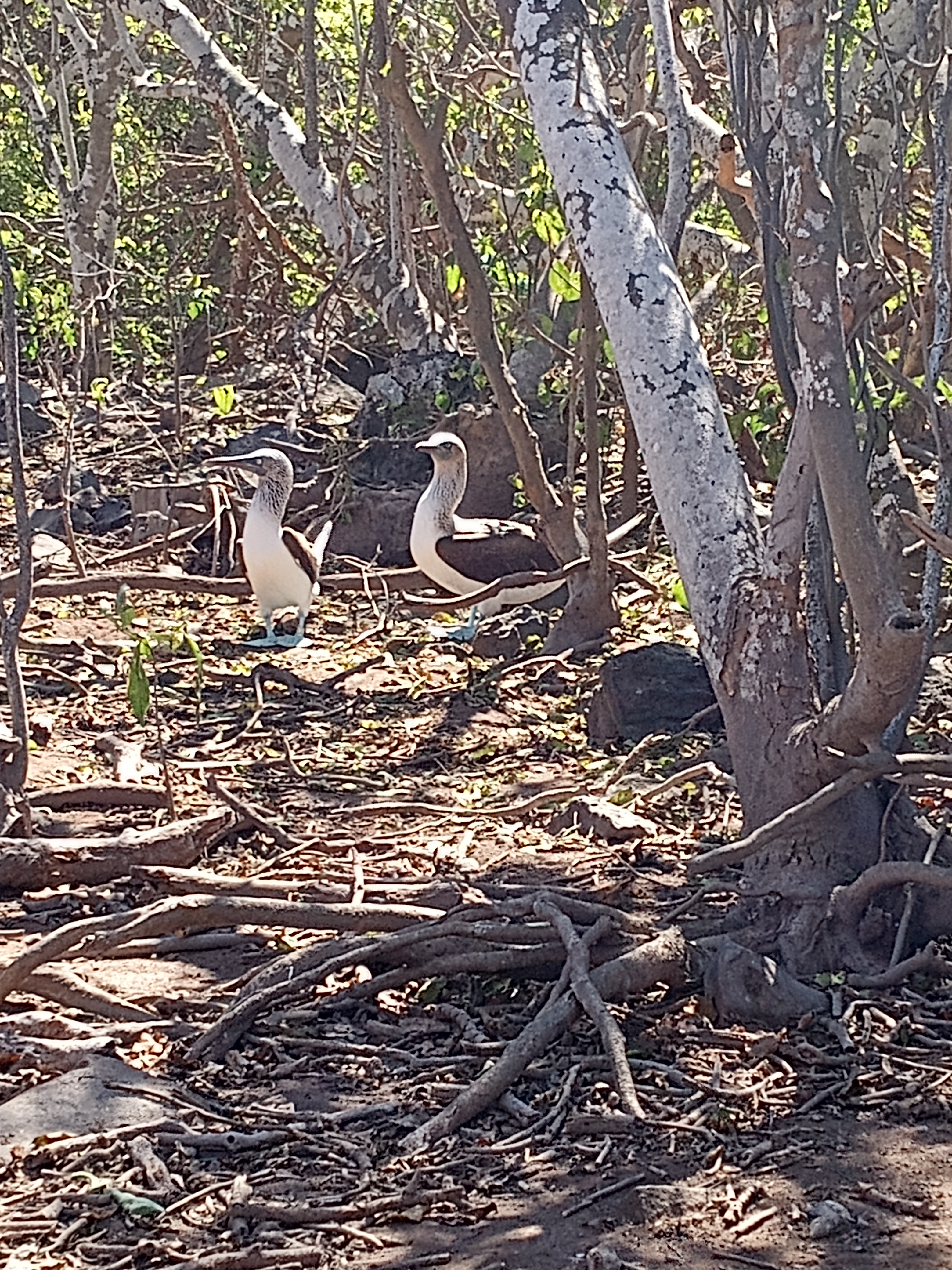
2. Seeing the Blue Footed Boobies at Isla Isabella – seeing the blue footed boobies has always been such a dream for me and in all of our bouncing back and forth across the sea, we were not able to stop in at Isla Isabella until this last crossing. We were so grateful to be able to stop in for the day and see not only the boobies but also frigates by the thousands. Our stop was brief (the anchorage was frankly a bit scary so I was not sad to not spend a night there) but we made the most of our time and I finally got to see the characters that are the blue footed boobies. My only regret was that we were too early for any fledglings to have hatched – there were lots of ornery mamas sitting on nests (many of them square in the middle of the path!) but no babies. This was truly a bucket list moment for me and I was so happy to be able to tick it off!
3. La Cruz cruisers gatherings – La Cruz has an amazing cruisers community and the local sailmaker makes it even better by holding weekly meetings for people getting ready to depart across the ocean. During these Friday meetings, we had presentations put on by representatives from Fiji and New Zealand as well as information sessions on weather, the coast guard, passage planning and all other manner of topics. It was a great opportunity to discuss weather windows as they started to approach. The sail loft has a library of charts and they arranged for copies to be made for all who needed them. In addition to the weekly meetings, La Cruz has some great restaurants which allowed for some fun nights out with fellow cruisers – both those headed out at the same time as us and with those we would be leaving in our wake. I believe that being with this group of likeminded and supportive sailors gave us a bit more motivation and confidence to ready for the crossing.
4. Crossing the Pacific – what an epic feat that was. Our first big jump across the Pacific was challenging in so many ways but also gave us so many moments of beauty and wonder. Realizing we had only made it 1/3 of the way across the Pacific when we arrived in French Polynesia was a good reminder of how truly vast the Pacific is. We crossed the equator for the first time on this trip – turning us from Pollywogs to Shellbacks – to be safe we made a tribute to Neptune and then reveled in our new status! The idea of crossing the ocean had been so daunting – I am not sure we really understood what we were taking on – but we felt such a great sense of accomplishment in achieving that goal!
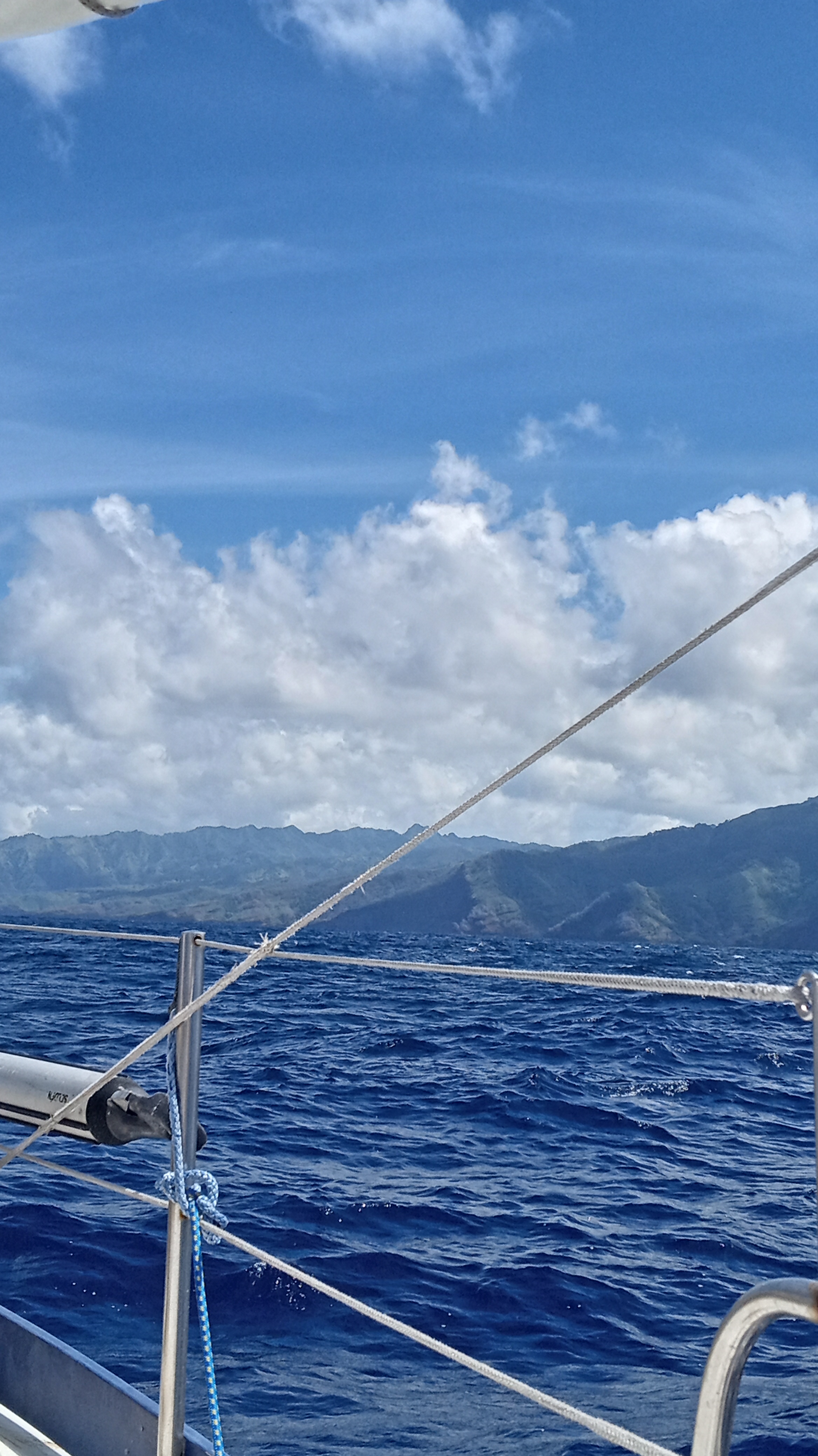
5. Landfall in Hiva Oa – that first sighting of the lush and magical land of Hiva Ova was so breathtaking. As we approached land, we could smell the earth – an incredible thing after more than 30 days at sea – and we could see the everchanging colors of green towering over us. It was such a truly breathtaking moment. Sadly, the anchorage at Hiva Oa was a true nightmare but that first glimpse of land was still such a treasure!
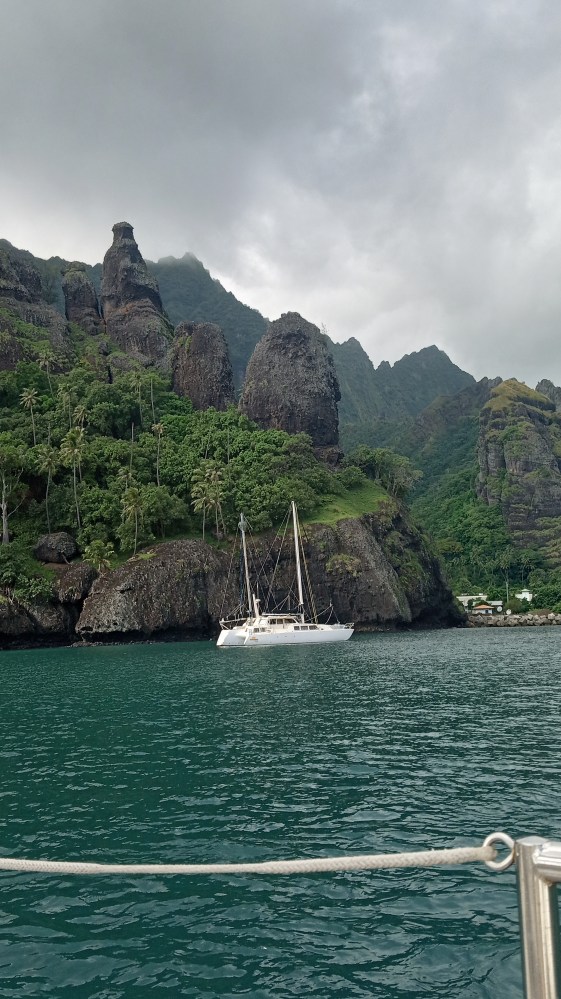
6. Fatu Hiva – if you google the Marquesas, you are likely to see a picture of The Bay of Virgins at Fatu Hiva – the magical, mystical beauty of this bay is unparalleled. This was one of our bucket list items for the Marquesas – it was gloomy and drizzly and the anchorage is so deep that someone dragging was a daily event – and even so, it was pure magic!
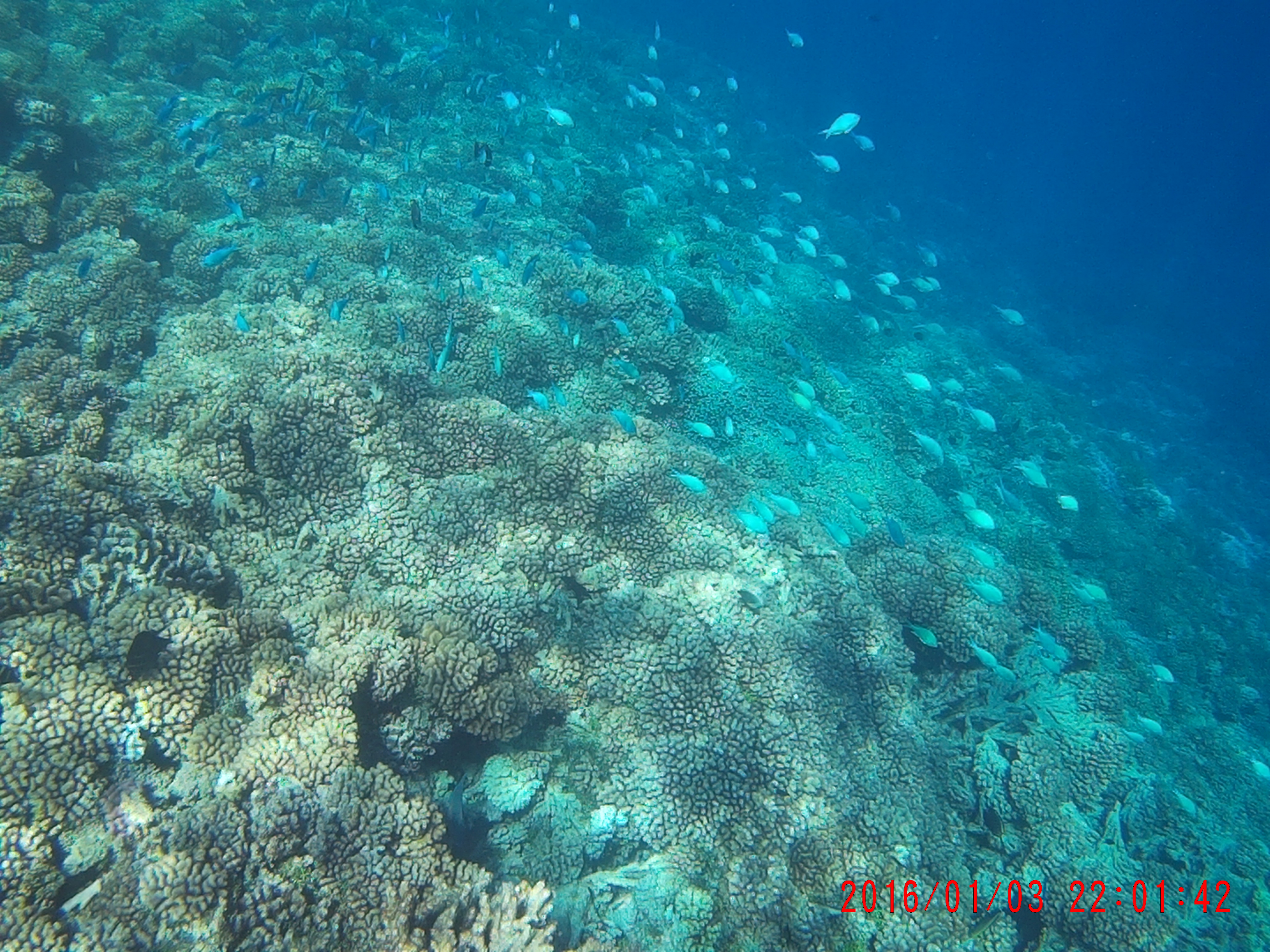
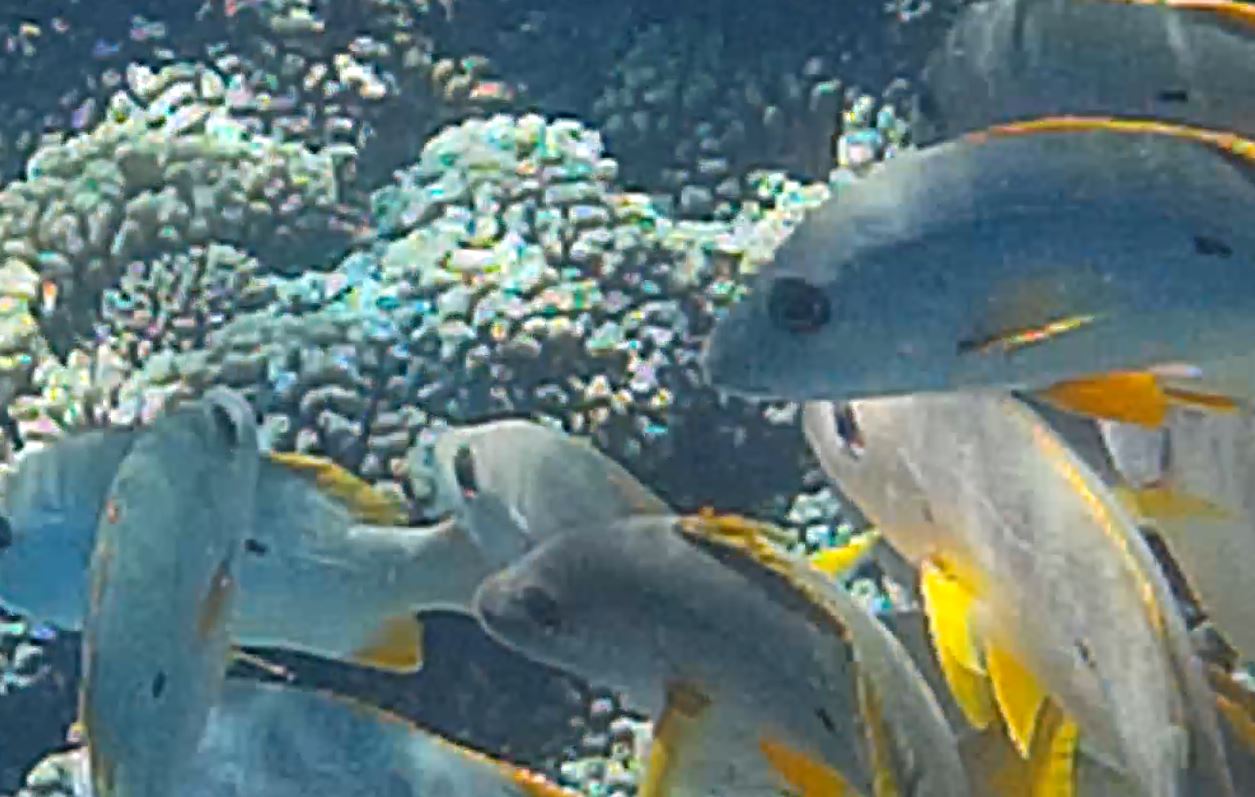
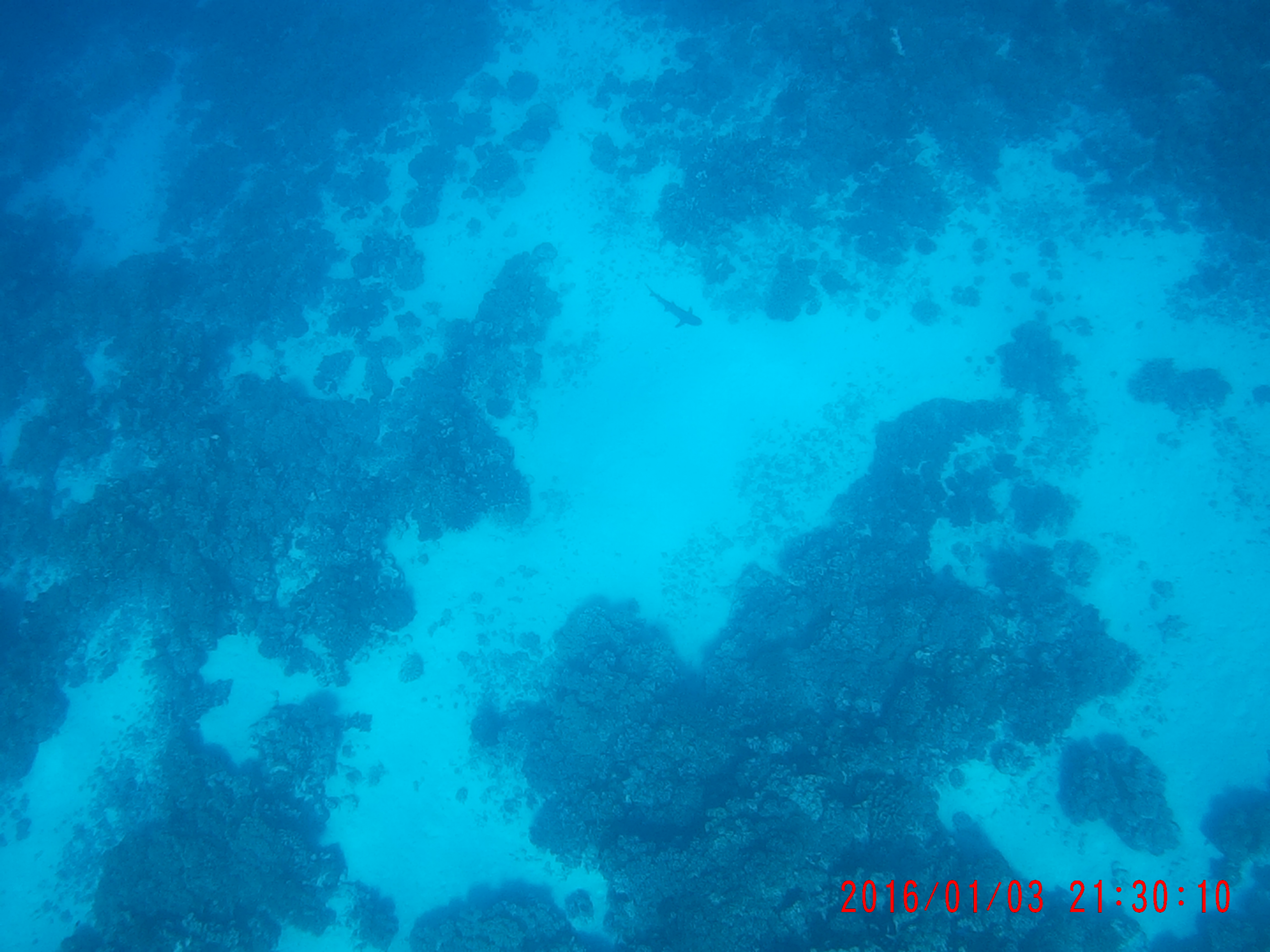
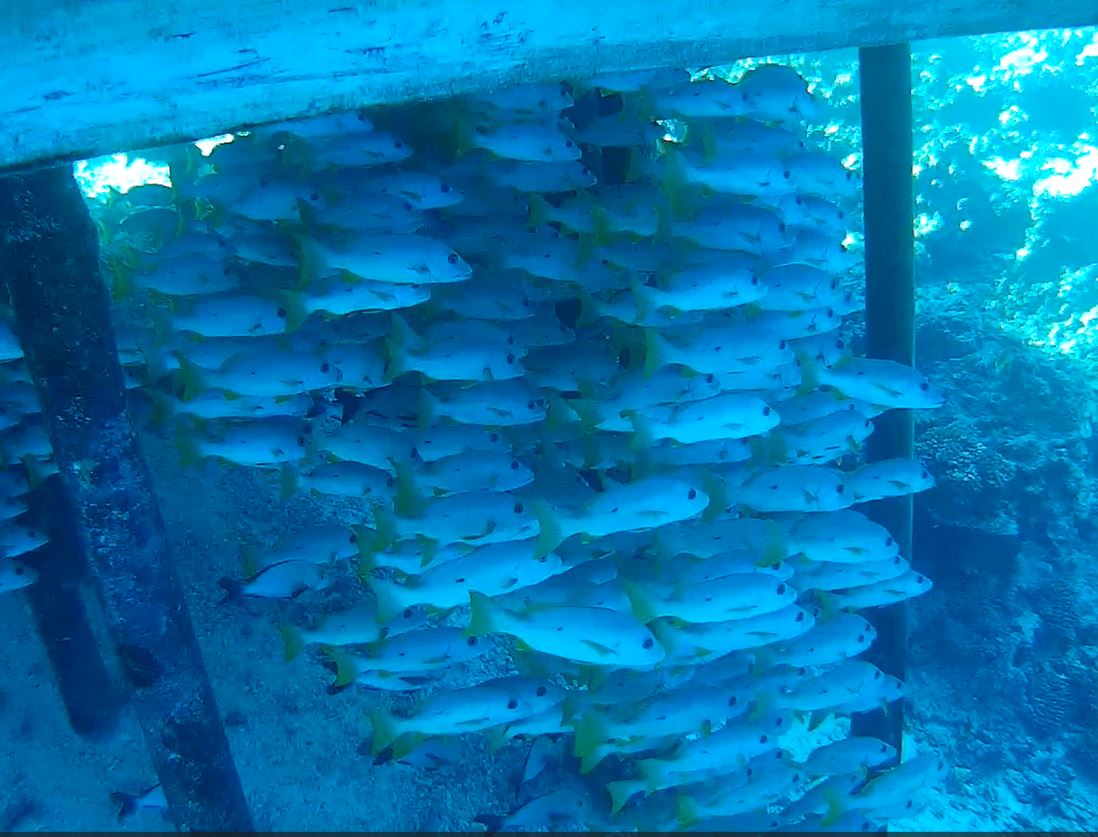
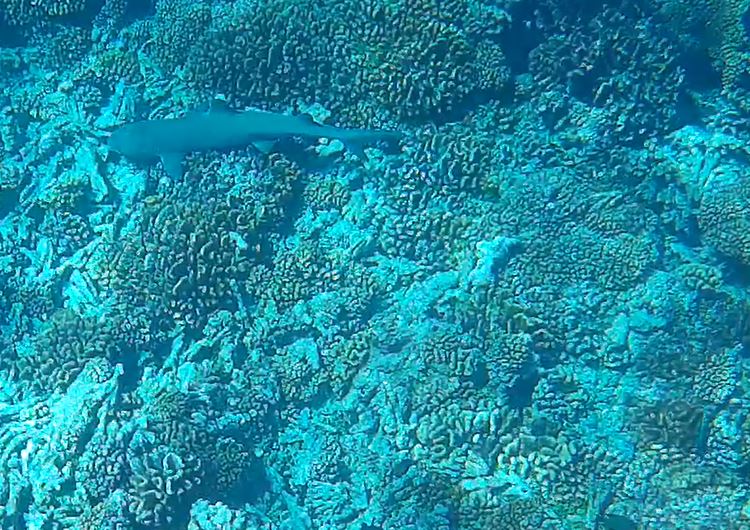
7. South Pass Snorkel – Fakarava – Fakarava was our only atoll and on its own it was amazing. The water was crystal clear, the community was lovely and the fact of being anchored inside of a reef was just simply cool. But for Owen, being able to do a drift snorkel through the south pass was a dream come true – he saw multitudes of fish and sharks as he drifted through on the current – truly another bucket list item!
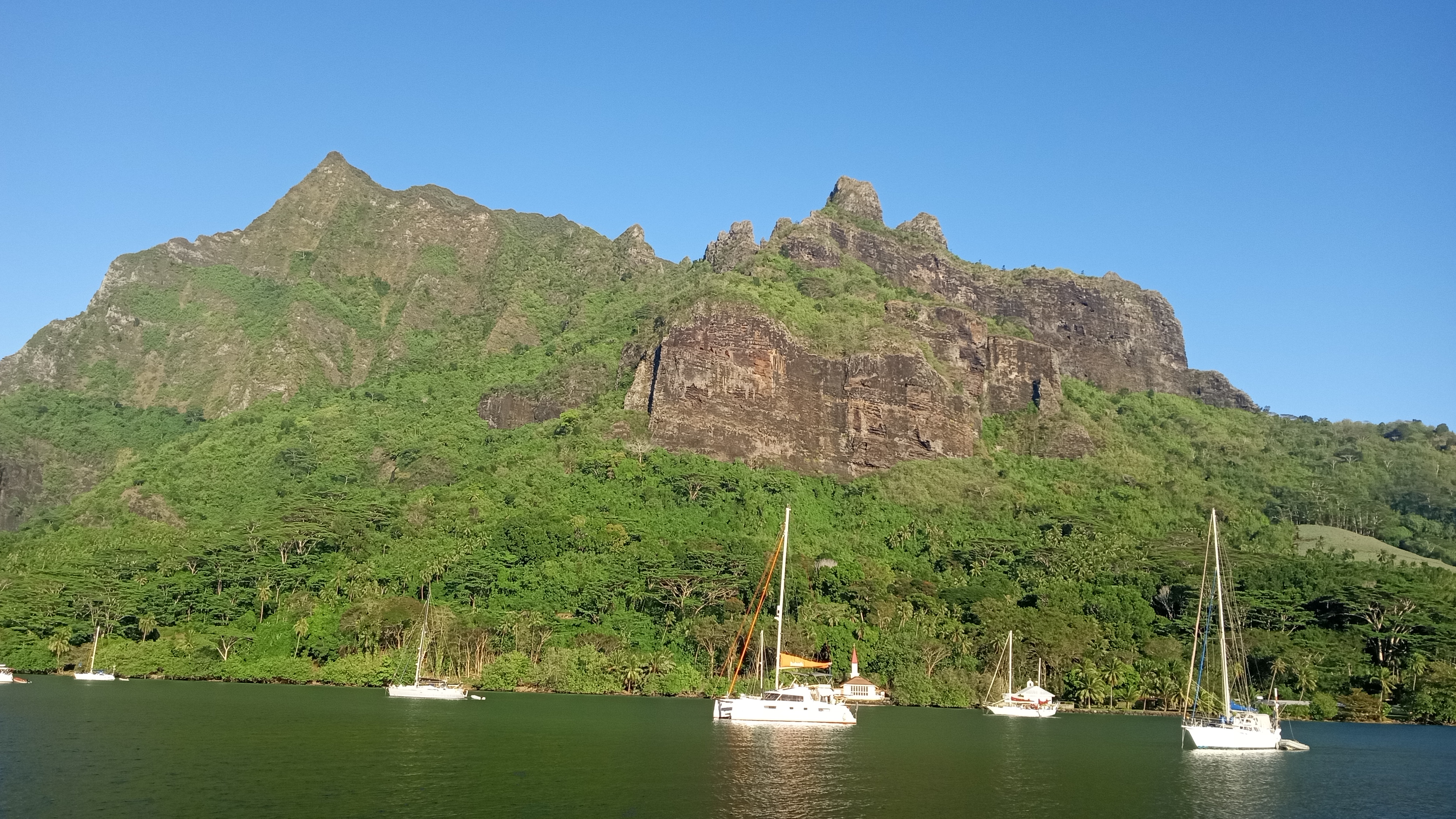
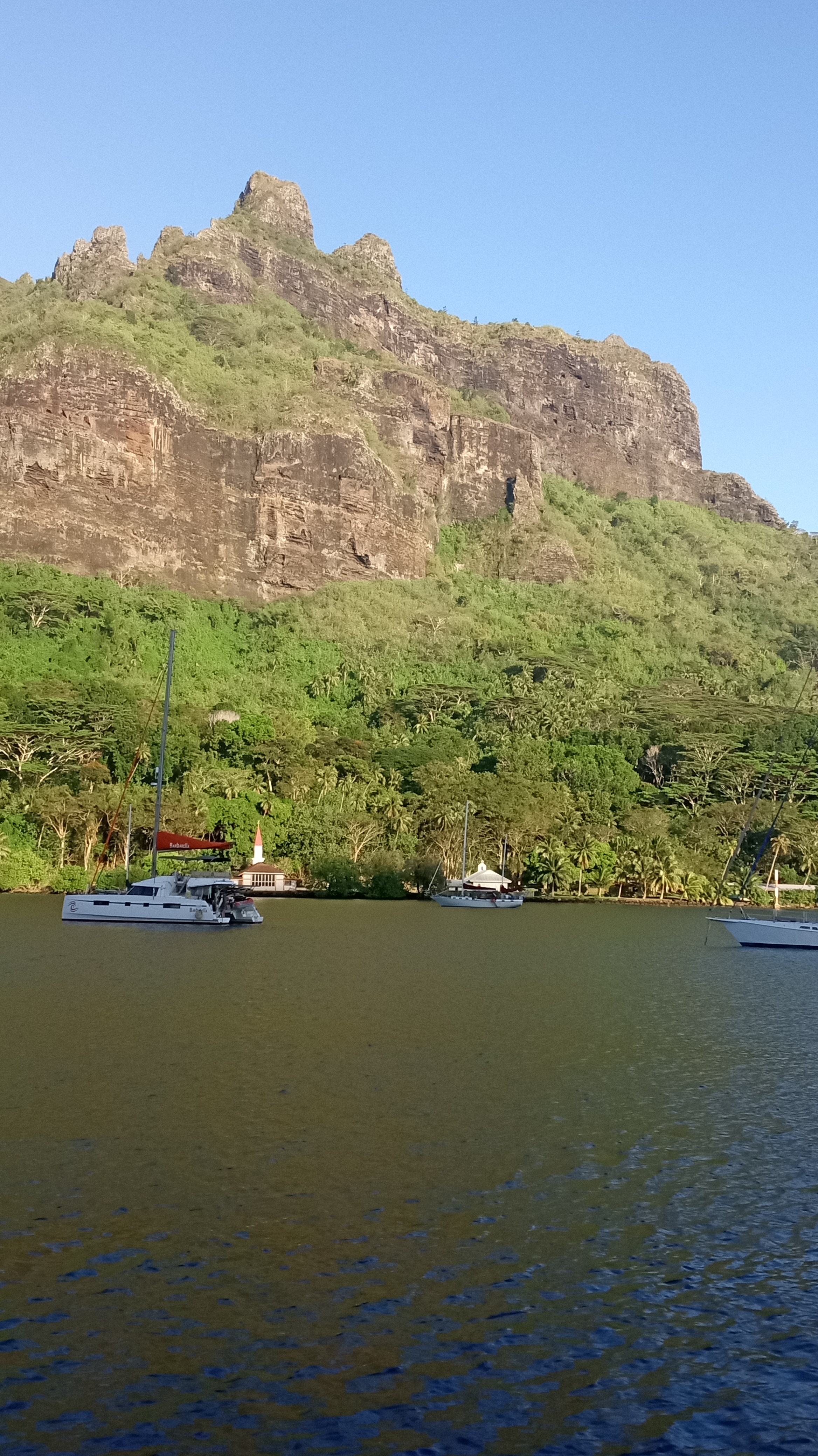
8. Moorea – Moorea was far and away our favorite spot in the Society Islands. Combining the imposing beauty of the Marquesas with the flat, calm waters of an atoll, Moorea was truly the best of both worlds. We anchored in Cook’s Bay, giving us easy access to town and stunning beauty. Our tour of the Island, made even better by doing so with friends, gave us a look at all of the beauty of the Island. Everywhere we went we were greeted with a smile. It was heartbreaking to sail away from Moorea – given more time, we would definitely have stayed longer!
9. Maupihaa – this was a totally unplanned stop that gave us one of our best experiences. It is stunningly beautiful and the locals that we met (just a couple of the very few people who live there) were lovely. We had the experience of being “trapped” with a number of other boats and that gave us the chance to meet many more fellow cruisers. With a potluck, a sing along, a walk of the atoll and simply stunning scenery in all directions, it was truly a stop to be remembered!
10. Tonga – Tonga stole our hearts and was our favorite stop of all. We so enjoyed our two months in the magical Kingdom and would have stayed longer if the seasonal weather had not pushed us along. The people of Neiafu, both locals and expats alike were wonderful and the anchorages were calm, peaceful and beautiful – as close to sailing at home as we experienced anywhere! Even with a full blog post on Tonga, I don’t think we managed to explain how much or why we loved Tonga but suffice to say we have left a piece of ourselves there and hope to be able to return.
We are in Fiji now and loving it as well – though we have only seen the marina and Savusavu so far! I look forward to much more exploring here next year, before we have to start the long trek home – 2025 should have some pretty epic moments as well!!
Wishing everyone the happiest of New Years and reminding you to chase your dreams – it is so worth it!!
We departed Fakarava headed for Tahiti with both a sense of anticipation and trepidation. For the last few years, there has been a constant stream of information coming out of French Polynesia, the Society Islands in particular, reminding cruisers that in fact, the residents of the Society Islands were just quite tired of us. There have been continually expanding restrictions on where you can anchor – some places have time limits and some are just prohibited. We have read story after story of people being chased away from anchorages because the residents on shore are tired of the visual pollution of a fleet of boats off of their beach. We arrived in Tahiti hoping it was not as bad as we had heard – sadly, it was.
Our arrival in Tahiti was later in the afternoon, after a two night passage. We knew we would not make it through the channel, past the airport and to either of the approved anchorages on the west side of Tahiti before dark so we opted to pull into Point Venus. In reading the Navionics notes we knew that anchoring in this spot was limited to 3 days but we only intended a one or two night stop to get ourselves settled. We anchored late afternoon, after a very slow trip through a small reef and directly into 25 knots of wind. The anchorage is beautiful, with a community park on one end and a few houses. We tucked the boat away for the evening, spent a few minutes out in the cockpit enjoying the surroundings and then headed to bed. The next morning we woke up square in the middle of a paddling regatta. There were small fleets of boats paddling different courses and nearly every one of those small crafts had a support boat – those boats continually buzzed our boat, moving directly under our bow, rocking us every few minutes and letting us know in no uncertain terms that we were in the way. We finally decided that it would be best to pull up anchor and head around through the channel, past the airport and to a hopefully more welcoming spot. There are two “anchorages” on the west side, one called the Airport Anchorage – nestled into a reef and notorious for dragging boats. The other is off of Marina Taina and we hoped to find a spot in that area. As it happened, a boat that was anchored in Point Venus would drag onto the beach a few days later, even making the local papers. The mayor of the town adjacent to the anchorage was quoted as saying that he already called for a ban of anchoring in the area and this was just another example of why. We were quite happy at that point that we had not stayed longer!
After a bit of a rolly trip to cover the few miles to the Papeete entrance, we made the turn towards the anchorage area. We called for permission to enter the airport channel when the signage indicated that we should and then motored through the shallow, narrow channel headed for the other end of the airport. The wind was howling and it was raining in buckets. Wind surfers and kite surfers were cutting back and forth across the channel adding an extra layer of distraction. We passed the Airport Anchorage thankful we had decided against staying there – the boats were bucking and pulling in the wind and each was nearly bow to stern – they were anchored that close together!! We were making our way towards the other end of the runway, desperately looking for the signage to indicate where we were to ask for permission to cross the runway again – when suddenly we realized that we were in fact right at the end of the runway and there was a plane approaching! With hearts in our throats, I slammed the boat in reverse, trying to keep us going directly backwards as, not only were we in the path of a landing aircraft, we were in the middle of two reefs with only a small distance between them. I was thankfully able to get us turned around in that area and then we motored back against the 25 knots of wind and pouring rain, holding station a bit off the runway until we could get permission to pass. While we were doing that, we could see the sign instructing you to call for permission to proceed – well after the runway!!! We were finally given the go ahead and started the proceed through, only to have yet another plane come down right in front of us!! Yikes – that was a scary few minutes!!! We finally made it through, past the airport and into the vicinity of the other “anchorage”.
There was some space to anchor nestled directly against a reef – given our proclivity for getting snagged on bommies, this did not seem like an ideal spot. The other side was pretty crowded and we milled about – thankfully the rain had stopped. We attempted anchoring in one spot only to realize we would swing out into the marked channel – we pulled anchor and moved a bit further in, anchoring between another cruising boat and one of the many derelict boats that littered the anchorage. It is no wonder that the locals are becoming disillusioned with cruising boats – there were many derelict boats (the one we were by was stripped of all hardware and had no mast – clearly not going anywhere soon!). Additionally, there was a very clearly defined no anchorage area (we worried we might be in it at first but on closer inspection confirmed it was closer to shore). It was in a bay that locals would swim in and would launch their boats for paddling practice – and though there were buoys marking it and it was clearly marked on the chart, there were several boats anchored within that area – a couple clearly derelict and a couple that were occupied by cruisers.
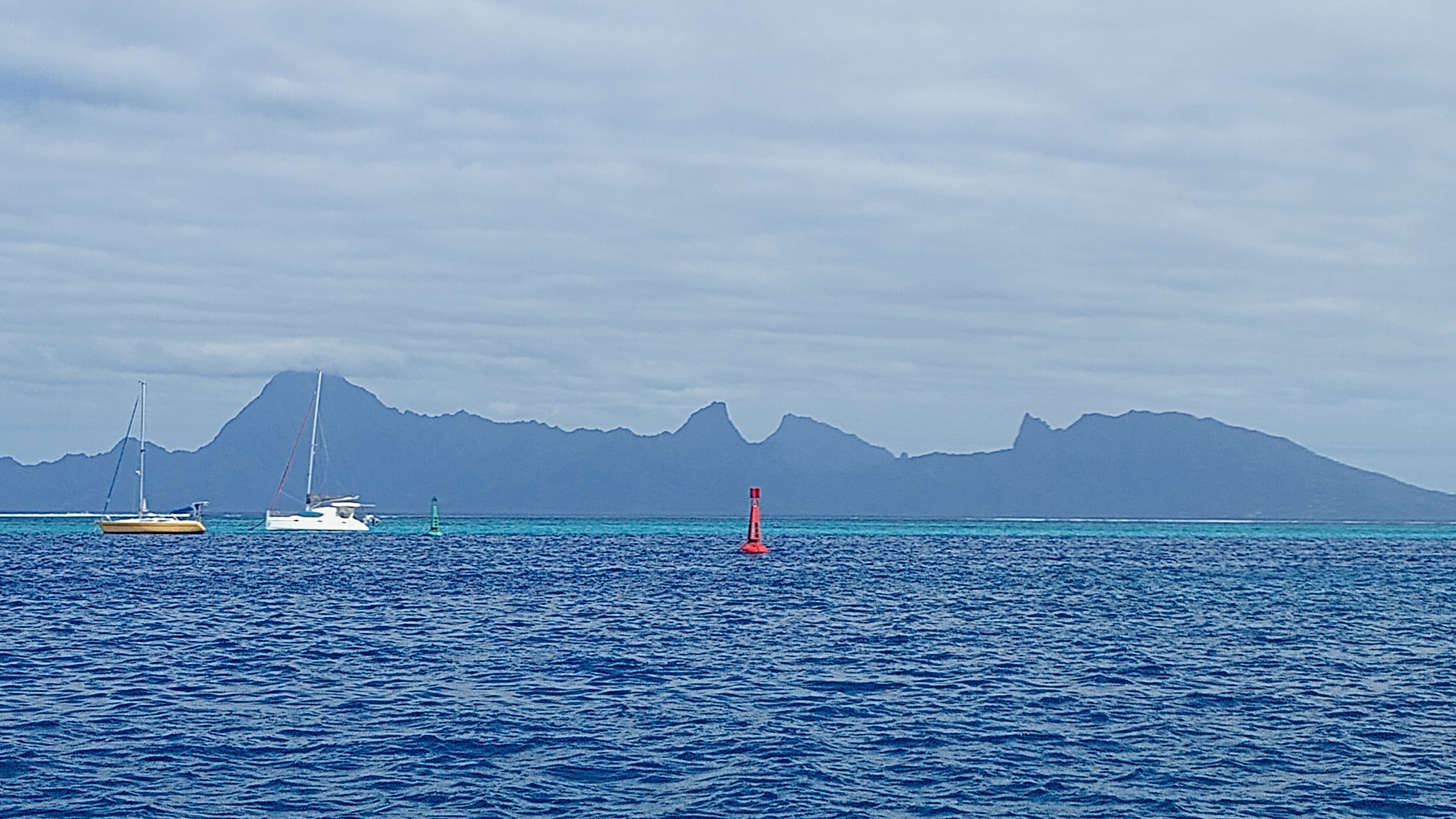
View from our Tahiti anchorage with Moorea in the distance
We settled in as best we could – we would actually end up moving to the other side of the derelict boat the next day because the wind has us pulling back quite hard towards another cruising boat and we knew we were making her nervous. The dinghy ride into the Taina marina was thankfully fairly short and there we found a free dinghy dock, a place to dispose of garbage and recycling and close access to a couple of grocery stores. After the limited access to grocery stores throughout all of French Polynesia, having a couple of large, very well stocked stores close by was a delight. There was a small restaurant at the marina that had happy hour – half price pina coladas and half price select pizzas each day – yes please!!!!
We were a little way away from Papeete but Owen knew he wanted to head in there to see if our alternator, which had not been performing as expected could be fixed. Given that the weather was calling for 30 knot winds, I opted to stay on board while Owen took a very wet dinghy ride to the marina and then grabbed a cab to Papeete. He spent the afternoon walking around between numerous shops – dropping the alternator off at one spot and then spending most of the afternoon trying to track down a spare belt for our spare alternator. I spent the afternoon nervously checking and rechecking our anchor line and anxiously watching as the derelict boat danced closer and closer to us – always seeming to be moving in a different direction from us. Owen finally arrived back at the boat, drenched and exhausted – the alternator had been left to be serviced so we knew we would need to go back into Papeete to pick that up.
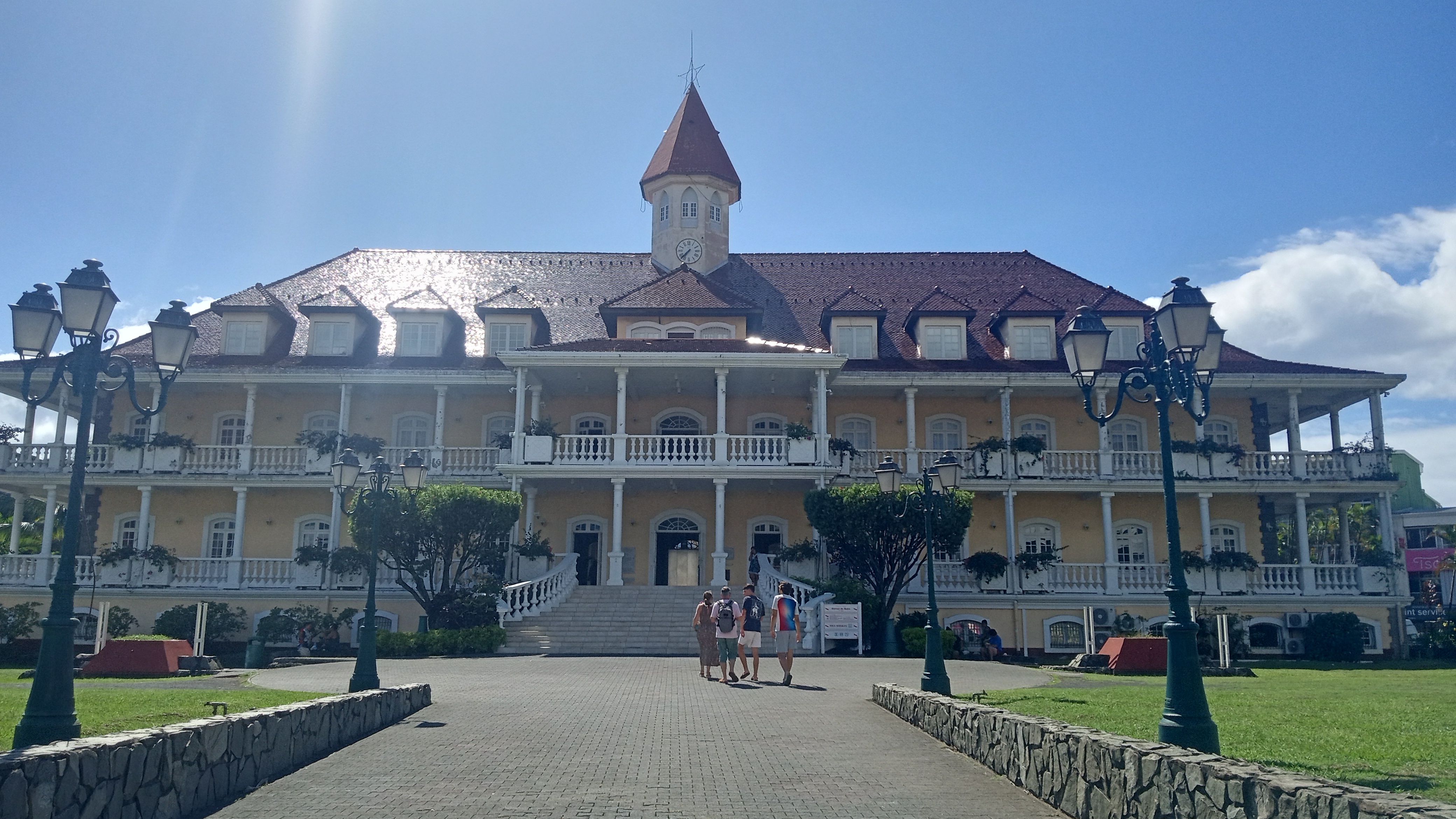
The next couple days saw us stranded on the boat in high winds, teeming rainstorms and bucking waves. We booked doctors appointments for a couple days later and so headed back to Papeete on a thankfully sunnier day. We caught the bus this time which, because the Olympics were on, with the surfing competition happening off the south end of the island, was free. We got off just a block away from the doctor’s office thanks to some other cruisers who knew exactly where we were going and when to tell us to get off. After quick check ups and prescription refills, we headed to do a bit more exploring. Papeete itself is rather uninspiring – concrete block buildings, many of which were quite run down. It looked somewhat like there had been a big building boom in the late 60’s or 70’s and then nothing since. The saving grace however was a gorgeous, miles long, waterfront park with walking paths and spots to sit and rest. They had a viewing area set up to watch the surf competition and many booths set up in support of Tahiti tourism and local initiatives. We explored this area and then had a wonderful lunch – the best burgers we had had since leaving Mexico – the first burgers we had had that were not frozen patties done in a fry pan so we enjoyed every bite!!! We finally headed to the alternator shop only to learn that our alternator had in fact “half failed” – it would only put out a maximum of 30 amps and they did not have the parts to be able to fix it. We ended spending way too much to buy a new alternator – one which would put out less power than our current one. We finally decided that we were ready to head back to our boat and discovered that as easy as it had been to get to Papeete by bus – it was not going to be so easy to get back. We headed to a bus stop where we waited and waited, all the while the crowds were getting bigger. When a bus finally arrived, it was immediately swarmed by the group waiting, and was full in seconds. We didn’t know how long it would be before another bus was going to arrive and given it was now about 5pm, we figured it too would be swamped. We finally gave up and opted to walk to a taxi stand and take a rather expensive ride back to the marina. Thankfully we arrived in time to catch the end of happy hour so we were able to solace ourselves with pina coladas.
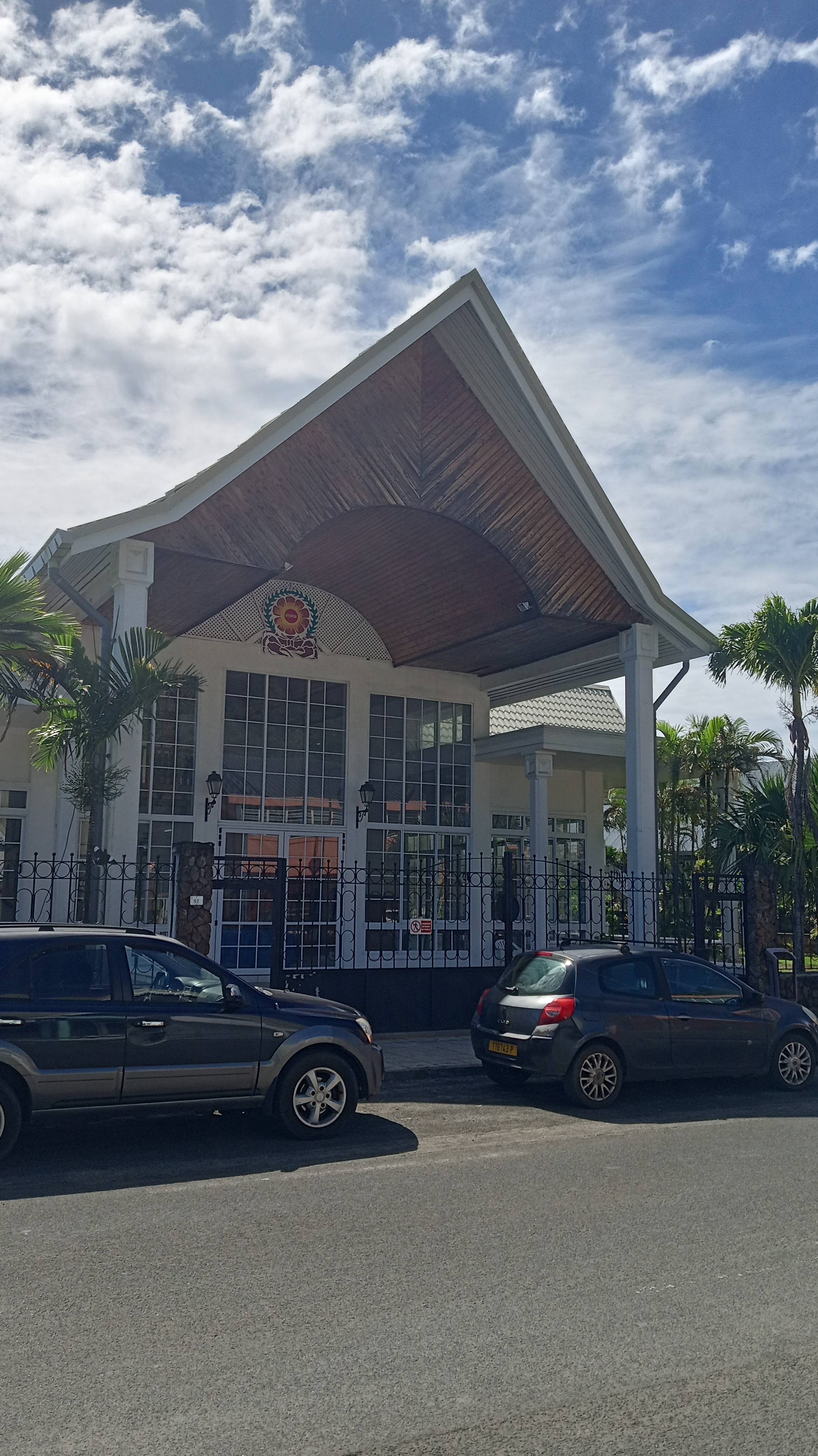
One of the nicer buildings in Papeete – the City Hall.
We spent the next day shopping at the Carrefour – a french grocery store on par with almost any store in North America. We spent way too much money but were able to stock up on cereal, nuts, iced tea mix – so many of the items that we had not been able to find to date. Sadly, our search for sour cream was again unrequited and the only cheese on offer was very expensive brie or Emmental – let me tell you, if I never have to have Emmental cheese again it will be too soon!!! I had discovered another shop a bit further out that seemed to carry a large number of Kirkland products so we again grabbed the bus and headed to that store – once again we were able to find mixed nuts, good quality paper towel and – most importantly! – my coffee beans. We were once again stymied by the busses though – busses were just driving right past the bus stop without stopping for us and eventually we just gave up and walked back the 2km to the marina with all our bags in tow.
We spent another afternoon on the boat during which Owen intended to install the new alternator – unfortunately, he first dropped it and then did something that caused a hell of a zap and smoke – though I could have already told you it was not going to work, he finished installing the new alternator, fired it up and …. Nothing. The brand new, very expensive alternator was at that point a very heavy paperweight!! Owen swapped back to the backup alternator and left the new one to be a problem for another day.
After a couple more days in Tahiti, having hit nearly every grocery store possible, obtained our refills for our prescriptions (ouch – not as cheap as Mexico, that is for sure!), enjoyed a couple of happy hours, and inexpicably having gone to McDonalds for lunch one day, it was time to move along. Our next destination was a day sail away – the stunning island of Moorea – and I was soooo excited to get there!!!
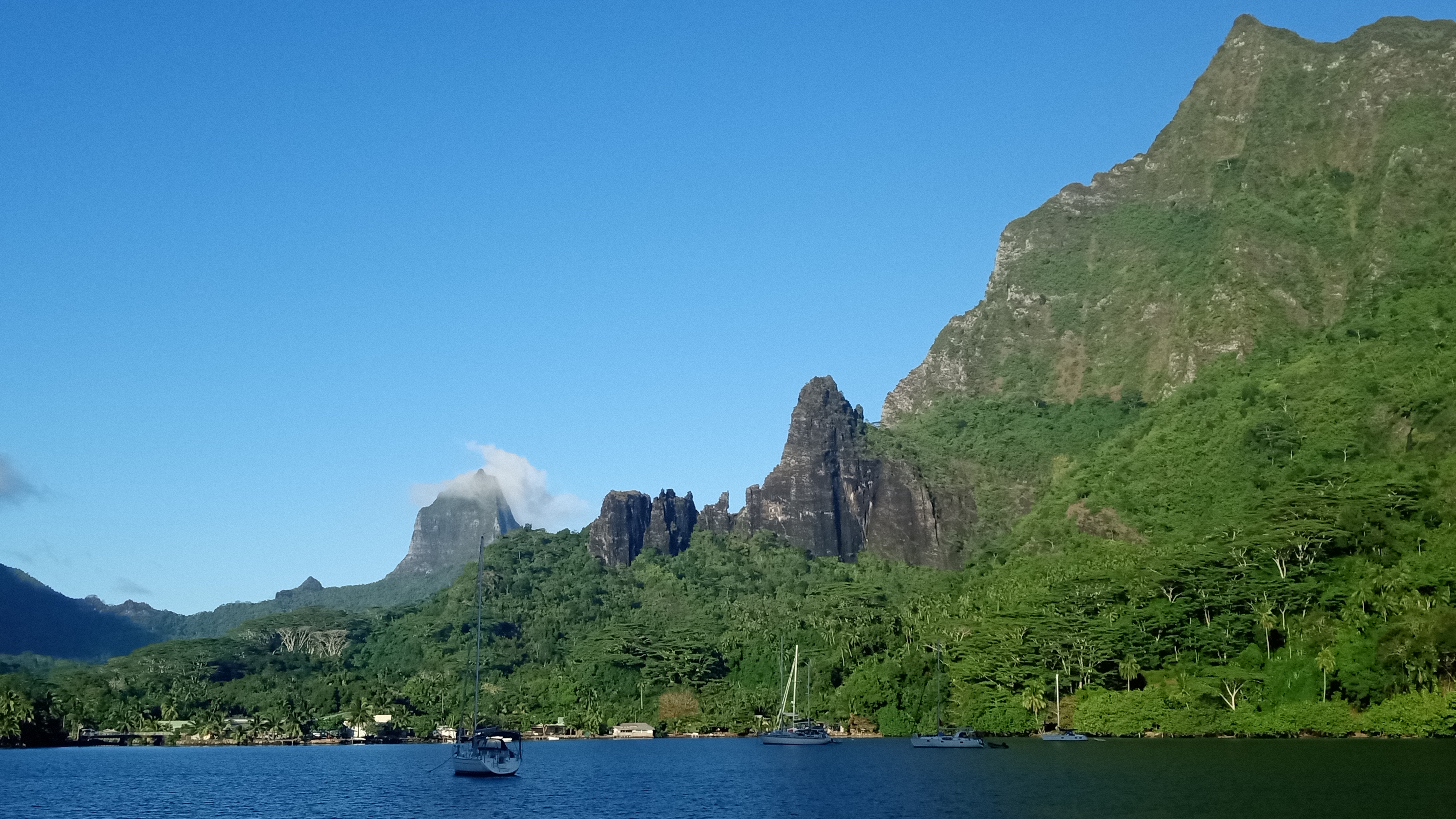
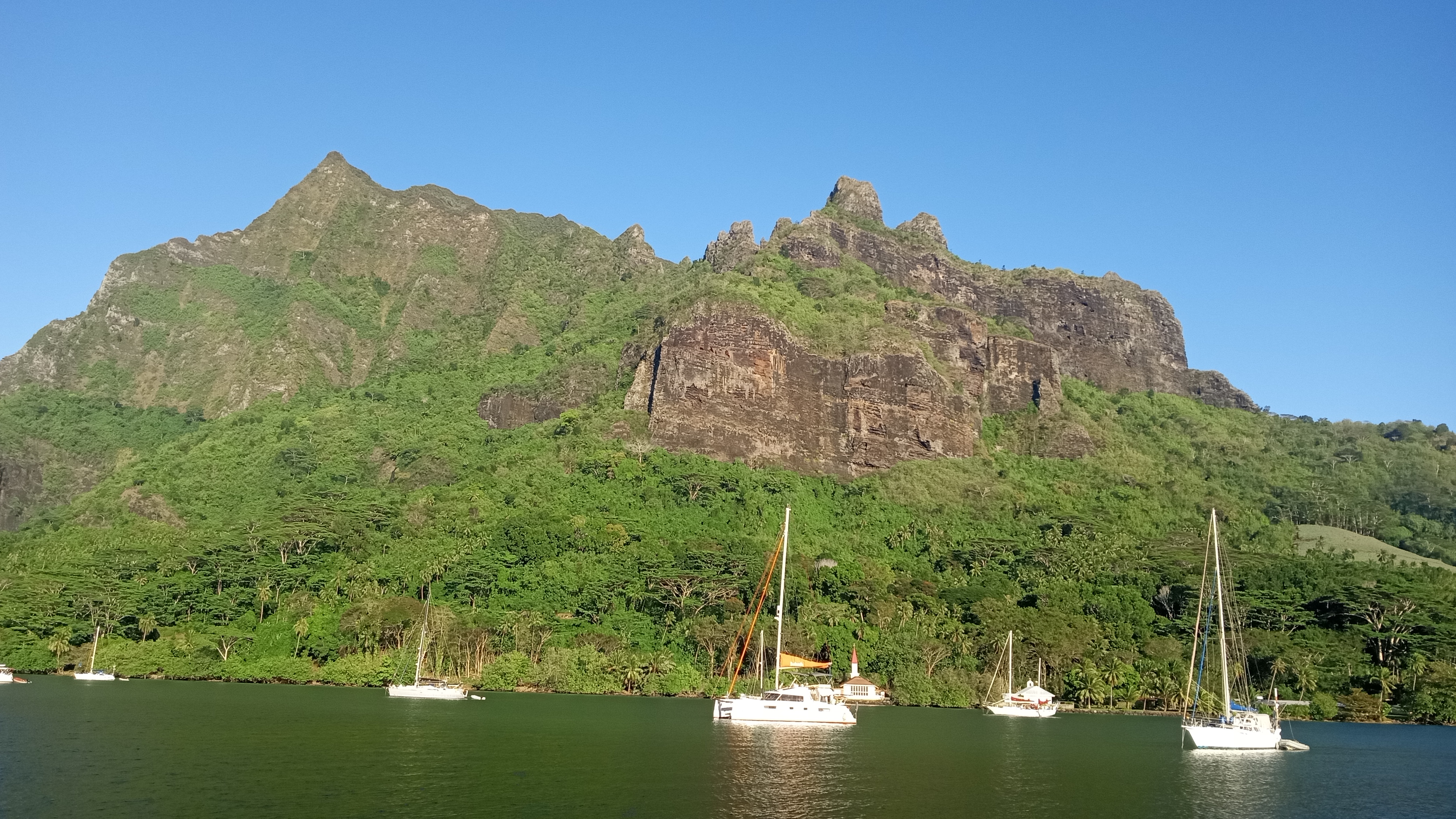
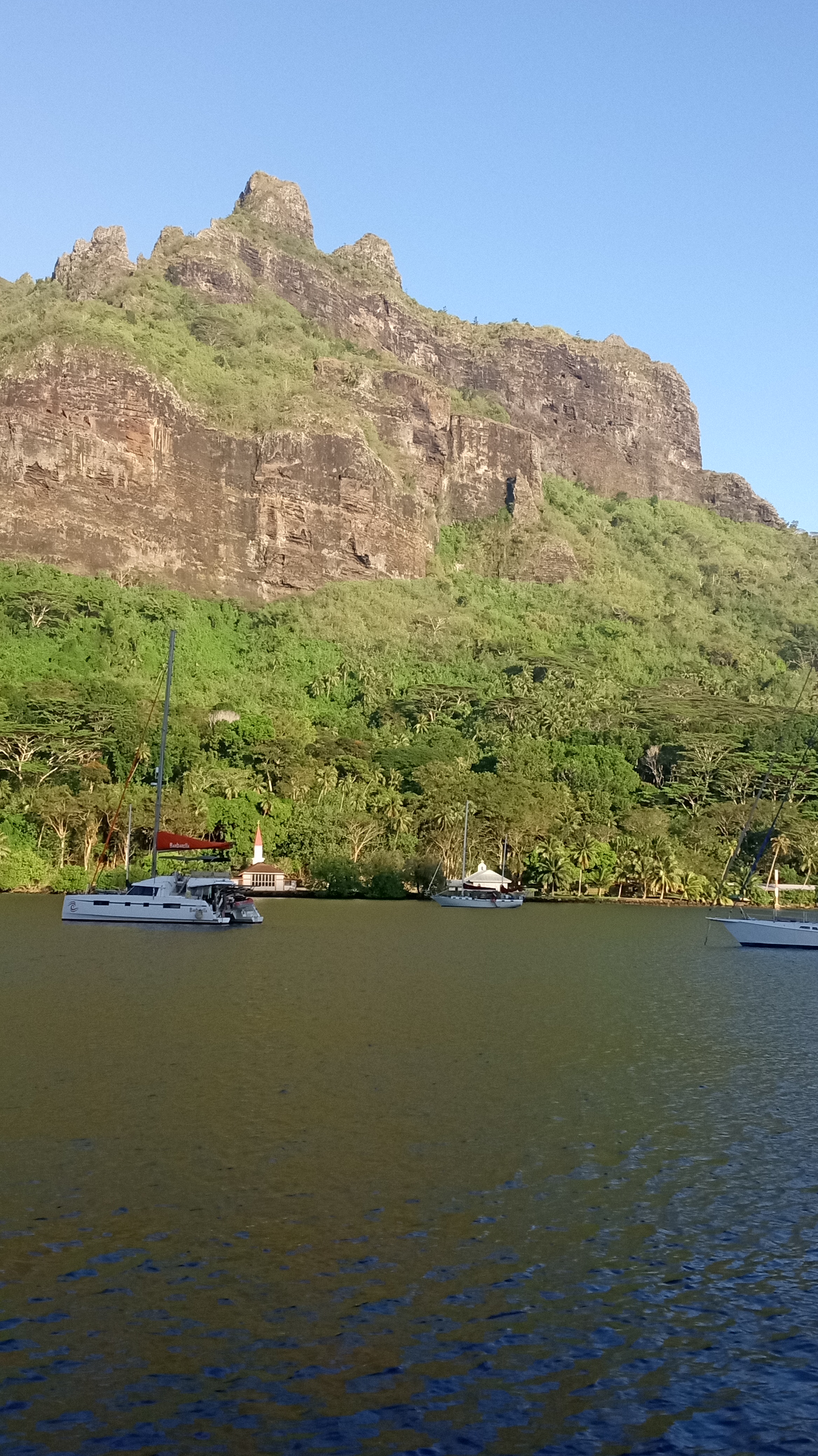
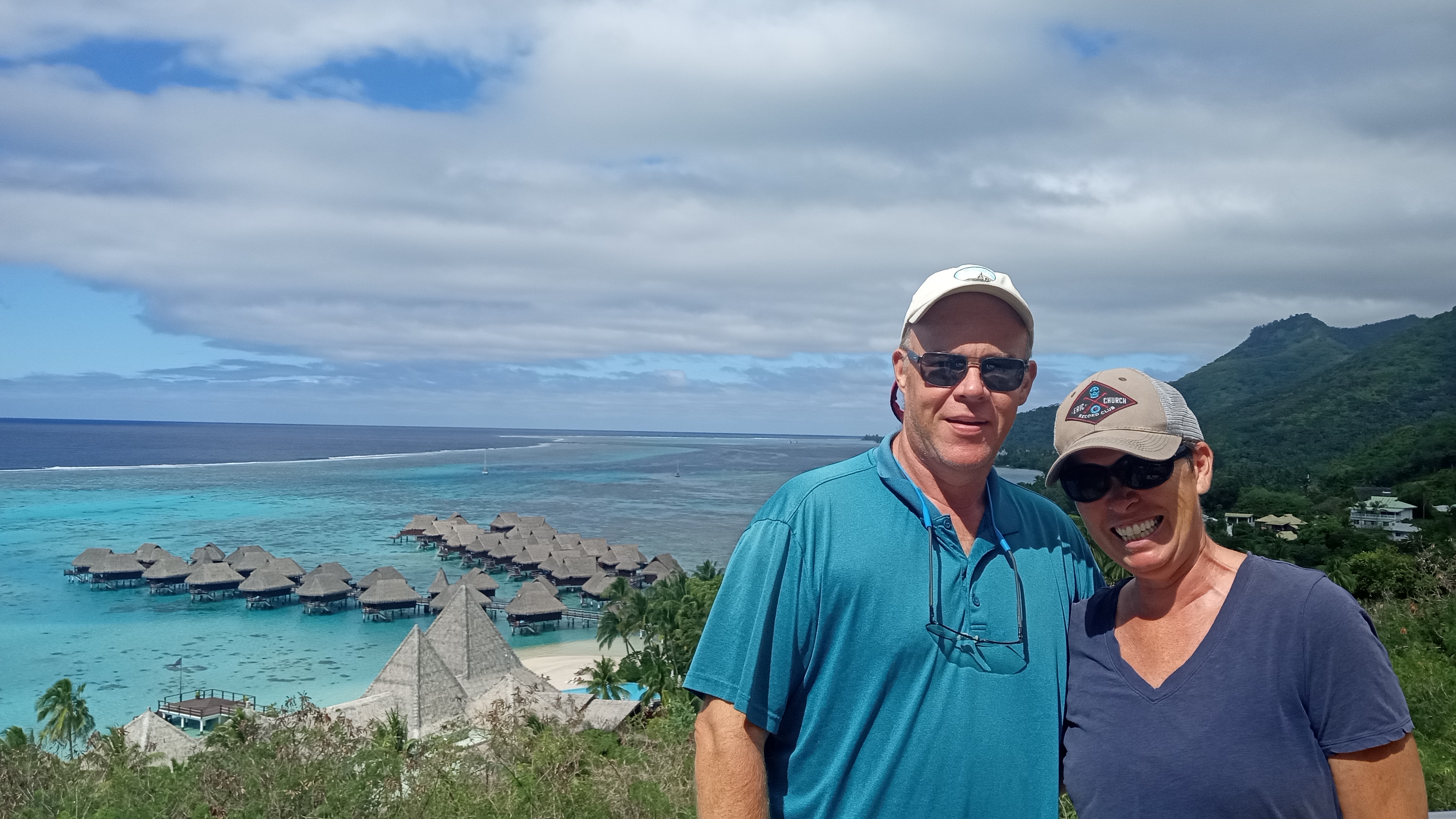
We headed out from our anchorage, thankfully through the west pass, which did not require us to make the return past the airport and motor sailed across the narrow expanse between Tahiti and Moorea – we headed in through the north pass and were soon anchor down in Cook’s Bay – a beautifully calm anchorage in the shadow of the towering mountains. It was the rich lushness of the Marquesas with the calm waters of the atolls and we were immediately smitten!
Cook’s Bay – so stunning!
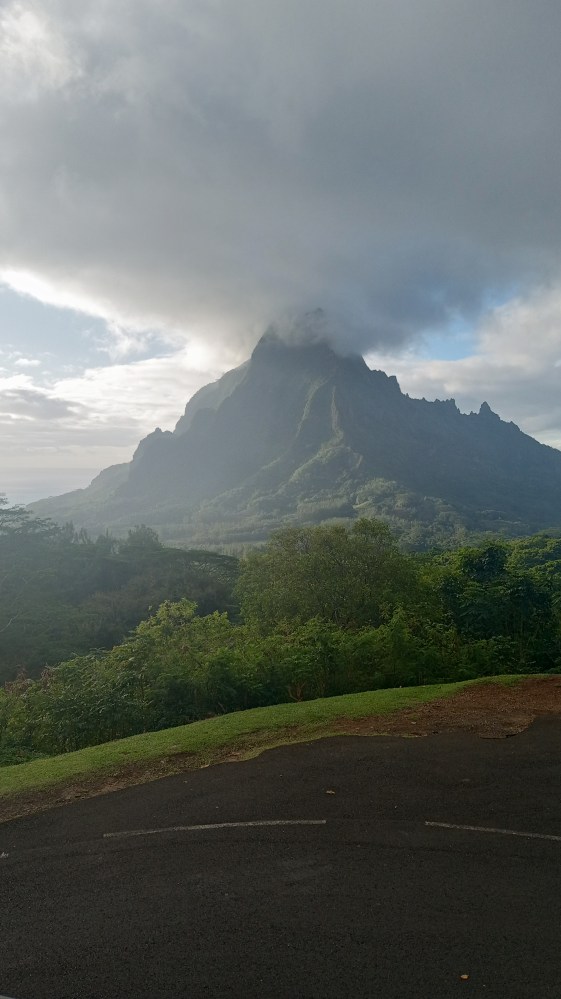
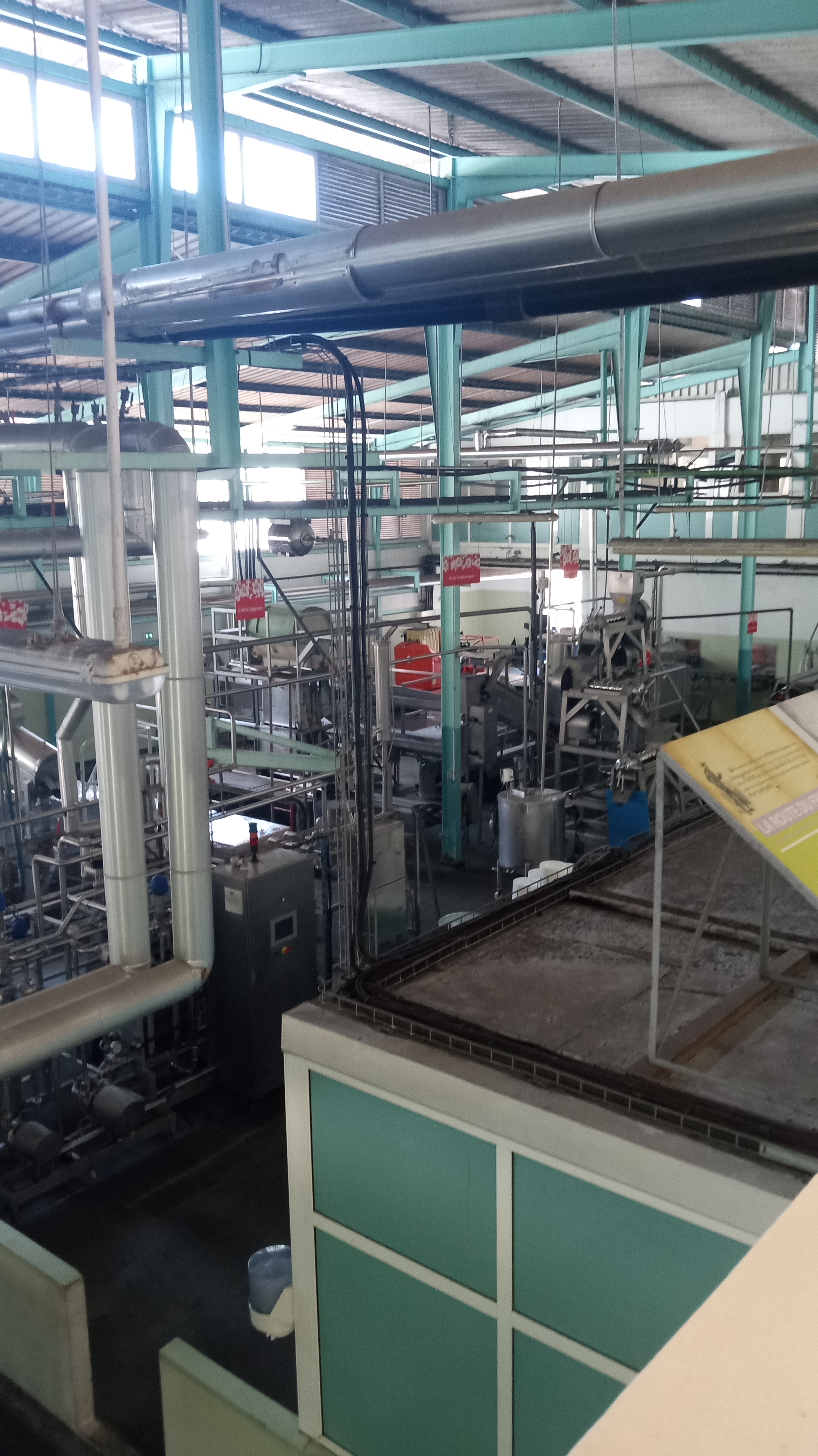
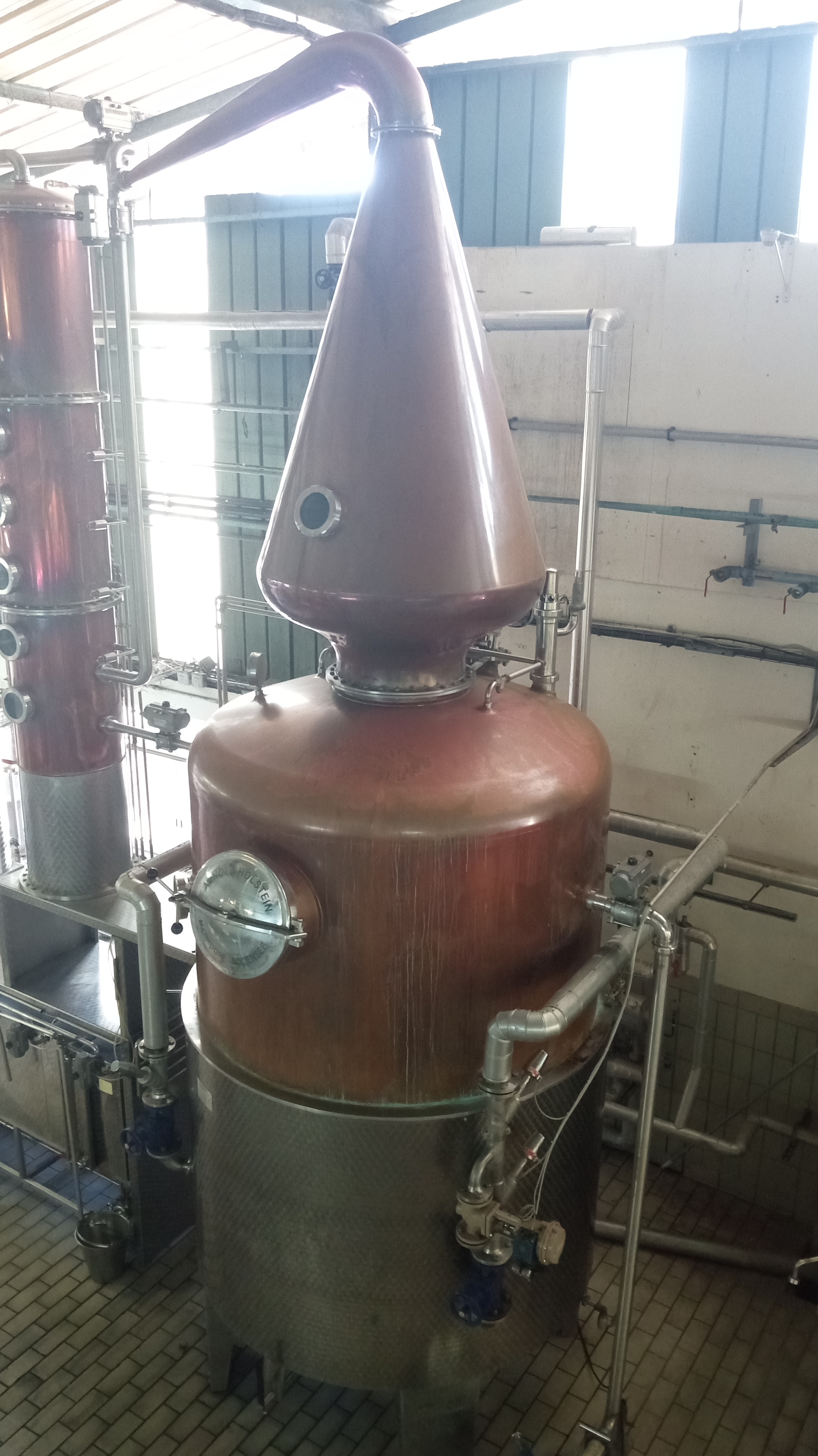
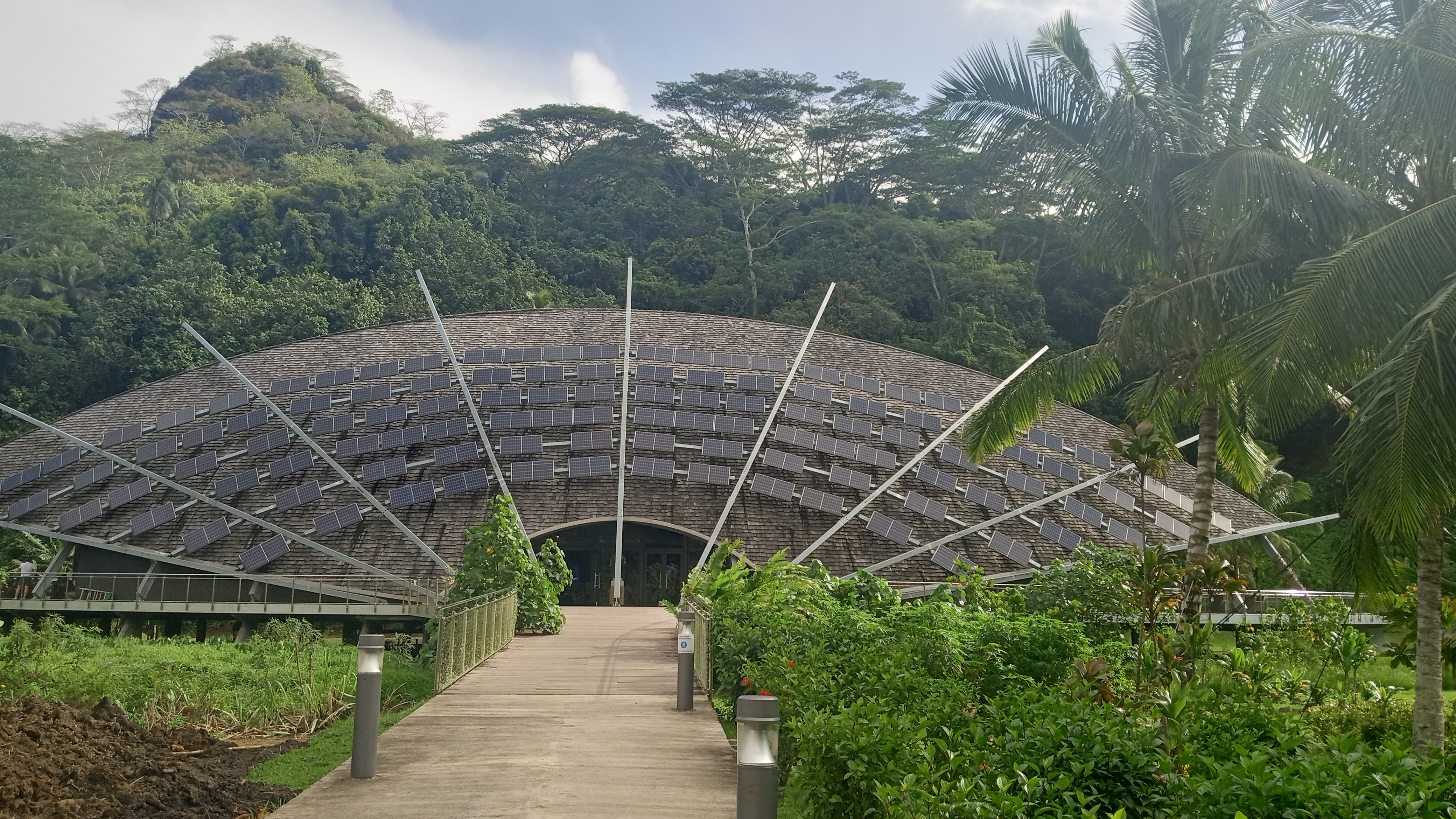
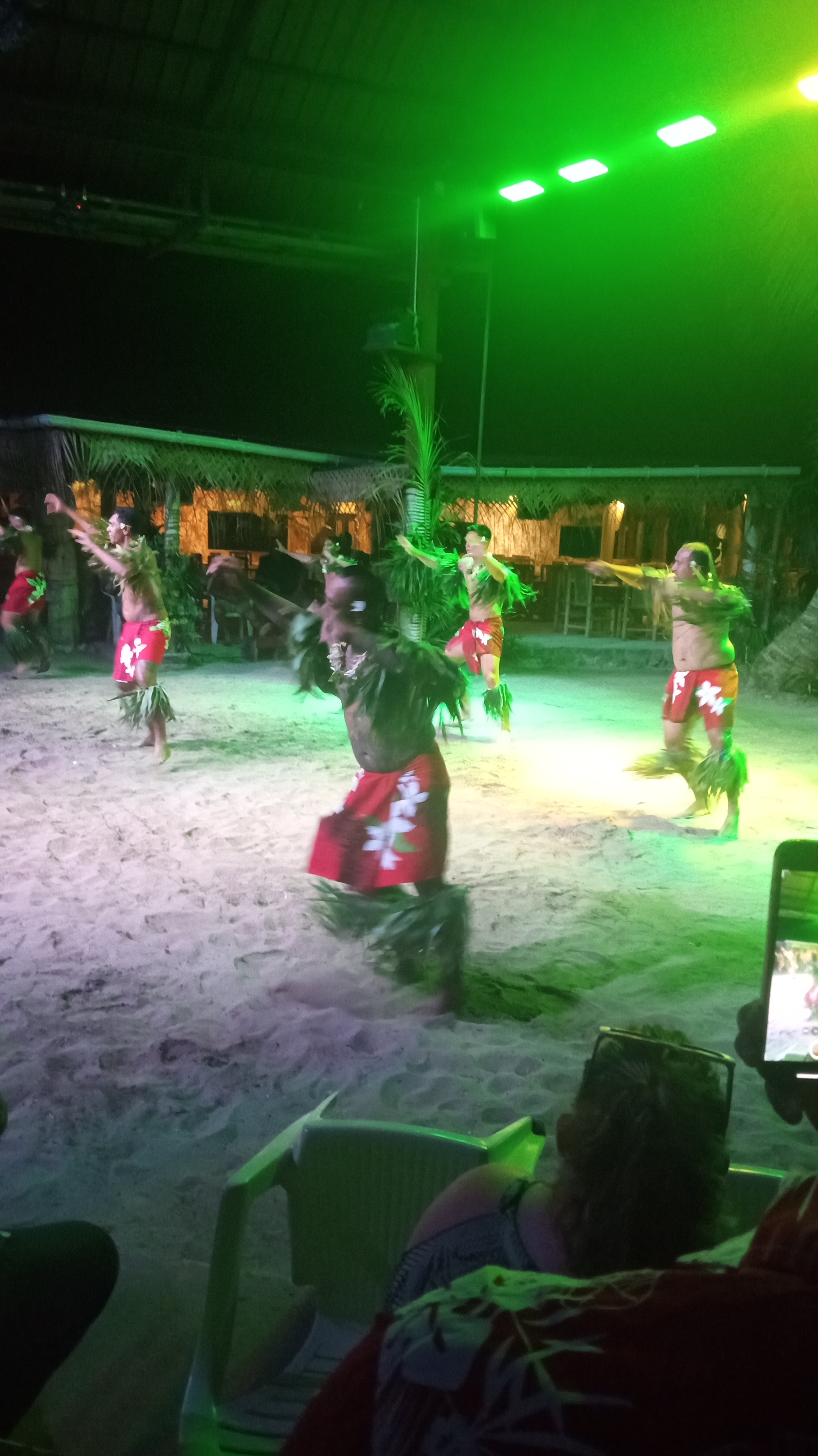
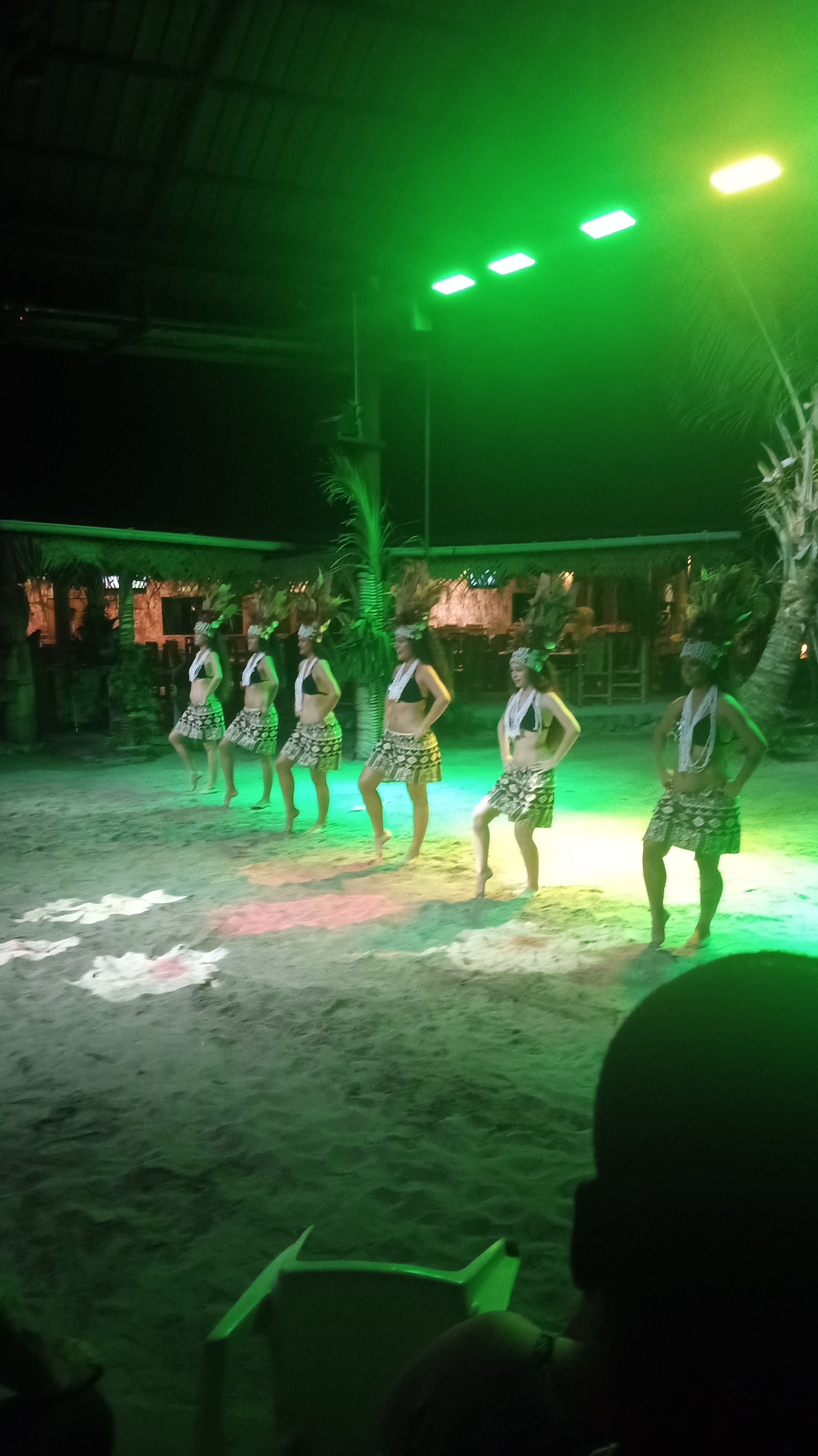
Our time in Moorea was spent exploring the Island. We took our dinghy around to the north end of the bay one afternoon and walked to a juice/ rum factory. They offered a self-guided tour of the facility and then a small tasting of one of their products. We treated ourself to a caramel rum liqueur (kind of like Bailey’s). Our friends on Exit had arrived in the bay and we decided to split a car rental. We made a loop of the Island, stopping at viewpoints and beaches, stopped for lunch and then drove up a terrifying road that wound its way up to a mountain side lookout – from the top we were looking out through the misty prehistoric greenery to Cook’s Bay. One of our stops was an eco-museum. None of us even knew the museum existed but the building was so interesting we were compelled to stop to see what it was. When we realized it was a museum we went in for a look around – we had actually arrived a few minutes after they normally let people in but they were kind enough to let us in, and we were given a personal tour by a woman who was the granddaughter of one of the last Island chiefs. It was such an informative afternoon – learning not only about the museum and their efforts to protect the coral environment, but also learning so many cultural tidbits about our guide’s family and life. We finished our day with dinner out near a small marina and then a trip to the Polynesian Village for their nightly show – it was a spectacular night of dancing, fire dancing and beautiful music. It was a spectacular day! We did a couple of other trips out around the bay, going twice to a bagel shop – real New York style bagels that were spectacular, a pizza place, creperie and a barbq place. There was certainly no shortage of wonderful eateries. The people here were spectacularly friendly and, so long as you were careful to mind the marked set off from shore for anchoring, we didn’t have anyone trying to chase us out of the bay. Our only challenge here was garbage – there was not a single garbage can on the streets or near the dinghy dock. Some people had been putting garbage into the dumpsters behind the grocery store so they had responded by locking the bin. Apparently, you could go to the town office and pay to dispose of garbage – this did not do us any good when we were trying to get rid of garbage on a Saturday (when the office was closed) before heading out the next morning on our next passage. This again was where the people were so kind – we went to the gas station to ask if they had a dumpster we could put the garbage in (we were happy to pay if necessary) – the clerk offered to take our stinky bag of garbage home with her to dispose of it at her house!! We just couldn’t ask her to do so but finally agreed to paying a fee to put it into the gas station’s dumpster. While we understood that it was costly to dispose of garbage, it seems silly to not give people somewhere to put their garbage – even someone local who has grabbed a drink or bag of chips – there are simply no garbage cans anywhere. The result of not having any bins anywhere in town was that there was a ton of garbage on the streets, in ditches and very notably in the water.
Juice FactoryEco Museum
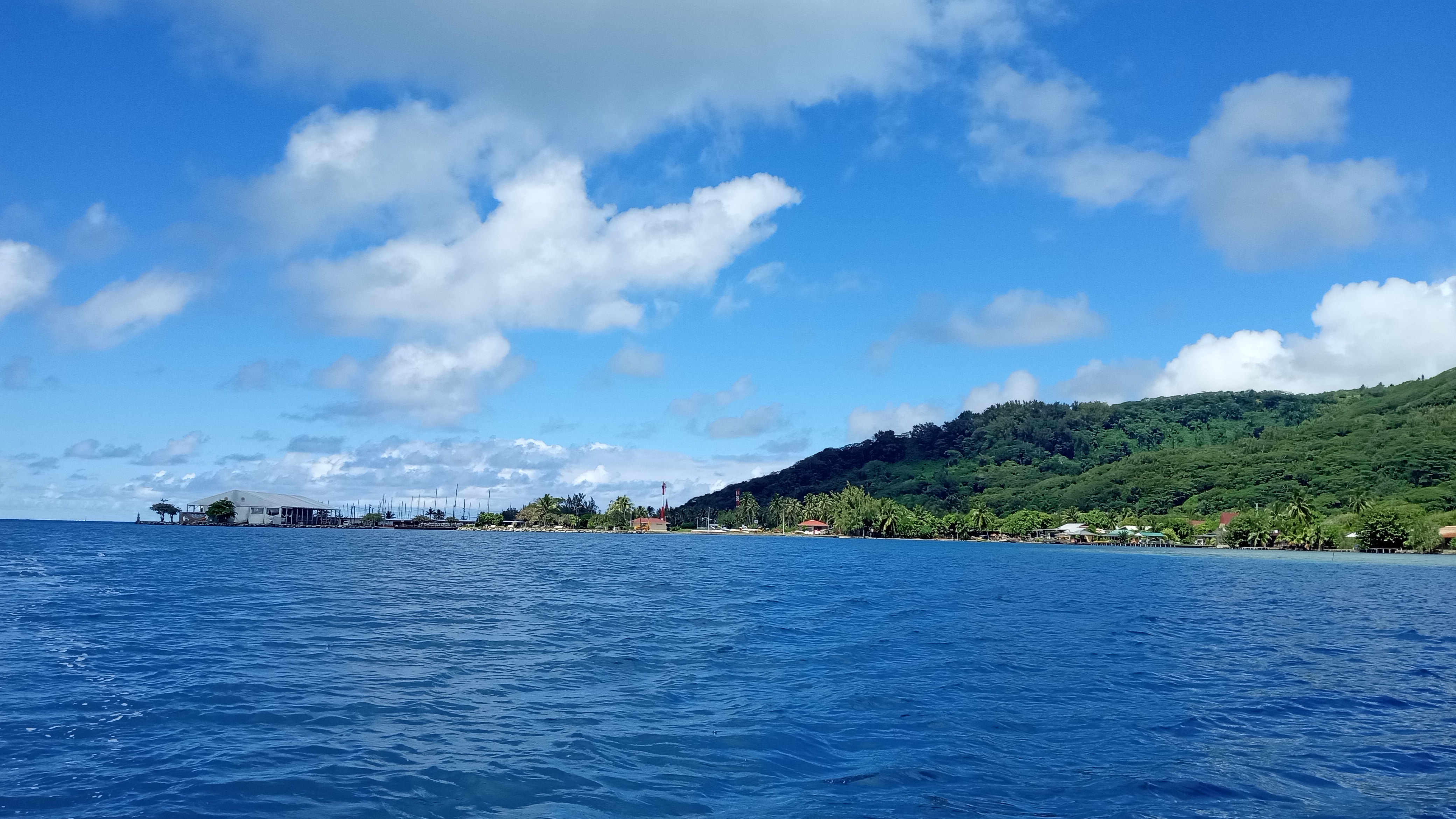
Though we were so sad to leave, the reality was that our 90 days was nearly expired and we still wanted to be able to explore at least one more Island. We headed out from Moorea, literally gloomily waving goodbye to paradise, making an overnight passage to Raiatea. It was a pretty rough passage with strong rain and high winds but the sun was shining when we came through the pass in Raiatea early the next afternoon. We headed around to the west side of the Island, near the boatyard. The anchoring was again difficult – either nestling in near a reef (no thank you), anchoring near a small Motu where you were limited to a 3 night stay, or dropping in 80 feet near the boat yard. There was a lot of small boat traffic, roaring by all day, so there were pretty constant wakes. We went ashore on arriving and had a taxi called to take us into town – it was a long walk otherwise – or a 2 mile dinghy ride. We went first to the Gendarmerie to begin the process of checking out from French Polynesia and then explored the small town a little bit. Though it is small, they do receive cruise ships quite often so there was a surprising number of small restaurants and stores. This is also a big base for charter catamarans so there were also 2 good grocery stores. We headed back to the boat and started to look at the weather for our departure. A couple of days later, we again needed to head into town to pick up our clearance paperwork. This time we took our dinghy in – and got monsooned on about half way around! We arrived in town dripping wet and went to get our clearance paper work. We also picked up some fuel and groceries before making the long trip back to the boat. Again, we started to check out the weather situation – it was not good. There was a system roaring in and it was certainly not the time to be leaving. The problem was that our visa was expiring and our clearance had been done – we were supposed to leave French Polynesia on August 18. August 18 came and went with us trapped on the boat in 30 knot winds and big seas – even inside the reef! Thankfully we didn’t see any sign of officials chasing people out of the anchorage we were in. Our friends were on a neighboring island and had been moved along from their anchorage at least twice before they just decided to pick up a mooring ball. I would have been so nervous being overdue on our visa if there had been officials rousting people in the anchorages there! After a week of sitting on the boat we started to have hopes for a new weather window in a few days. We again headed around from the anchorage to town in our dinghy to get fuel. We decided to have a quick lunch first and then pick up our fuel – unfortunately we didn’t realize that the harbour side gas station closed at noon on Saturday and would not open again until Monday – we were hoping to be able to leave on Monday so this was a problem. One of the locals told us that if we went around north of the harbour, we could walk to another fuel station – the reality was that meant we were tied to a concrete wall – with the waves crashing us against the wall and had to walk a couple of blocks through a field and around a fence to get to the station. I sat in the dinghy trying to keep us from ending up on the wall, and Owen made two trips to the gas station to get everything topped up.
Rainy passage to RaiateaThe closest we got to Bora BoraRaiatea Anchorage
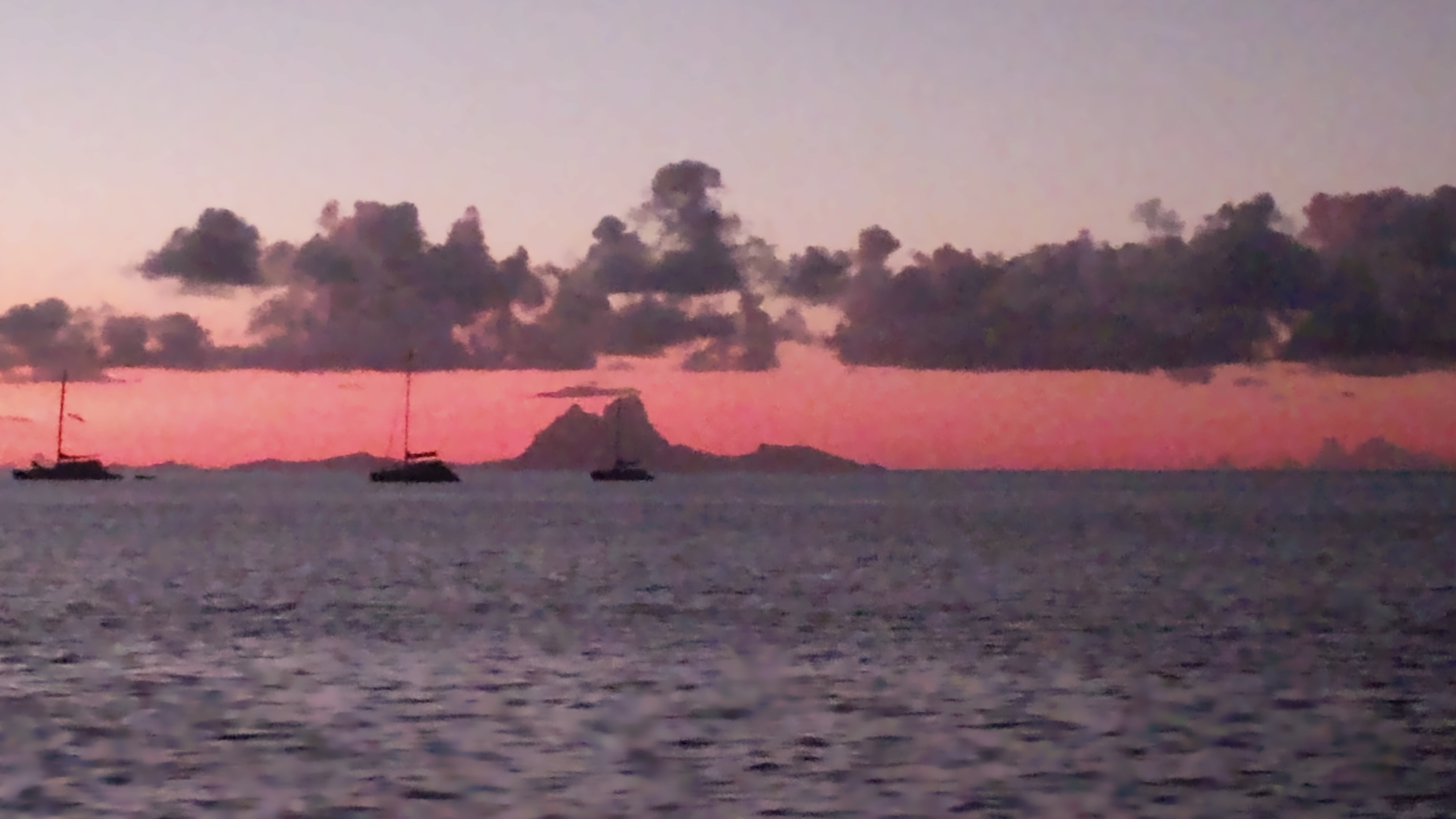
Our Monday departure was again not possible – the miserable weather just continued to pin us in the anchorage. Tuesday we again opted to head around for one more dinghy run for fuel and lunch – this time the gas station thankfully was still open when we went to fill up. Finally, on Wednesday, August 28 – 10 days after our Visa had expired, we had what we hoped would be a good weather window. Our plan was to head north west to Samoa – hoping to keep the next system to the south of us. We went through the west pass mid-afternoon – sadly sailing past Bora Bora. Owen had really wanted to go to Bora Bora but there is almost no anchoring allowed in Bora Bora (the one place you can anchor is very deep and you can only stay 2 nights) and the cost to stay there is insane – a mooring ball is about $75 Canadian and then they charge another $20 for the privilege of using the dinghy dock!! This was definitely somewhere that boaters are clearly not wanted and we just weren’t willing to spend that kind of money just to feel shunned!
And so it was that we concluded our time in French Polynesia – headed out for a 10 – 12 day passage to Samoa – or so we thought!!!
As we headed out from Clarion Island, intent on heading to the magic 10N-120W position, we were joined by one of the boats that had been anchored with us. We hoped to be able to sail in proximity to them for a few days but almost immediately those plans changed – we received a message from our router instructing that, rather than angling down to 10-120, we should sail due west to 120 and then sail South to 10N. Dakota, meanwhile, headed off on an angle (and arrived in the Marquesas 3 or 4 days ahead of us.)
Unfortunately trying to sail due west put us in very confused seas – we were sailing nearly dead downwind – not a fast point of sail for us and being tossed around relentlessly. We were taking waves from at least three directions with many of those breaking into the cockpit – and one of those going straight down the hatch, setting off the propane sensor alarm as it got doused in sea water. Everything was wet! I was very seriously wondering why we wanted to do this on more than a few occasions. We plodded our way slowly out to 120 W and finally were able to turn south – and again, the conditions were terrible. Almost immediately we were struggling through giant beam seas – rolling rail to rail and being tossed around with every roll. The going was not what one might call good!
And so we continued south, slowly and somewhat violently. We had warned our router that we were not a fast boat – I don’t think he understood how not fast we were until he was watching our very slow progress. There were days that we were barely making 60 miles a day – given the 3000 miles that we had to cover, this felt a little painfully slow!
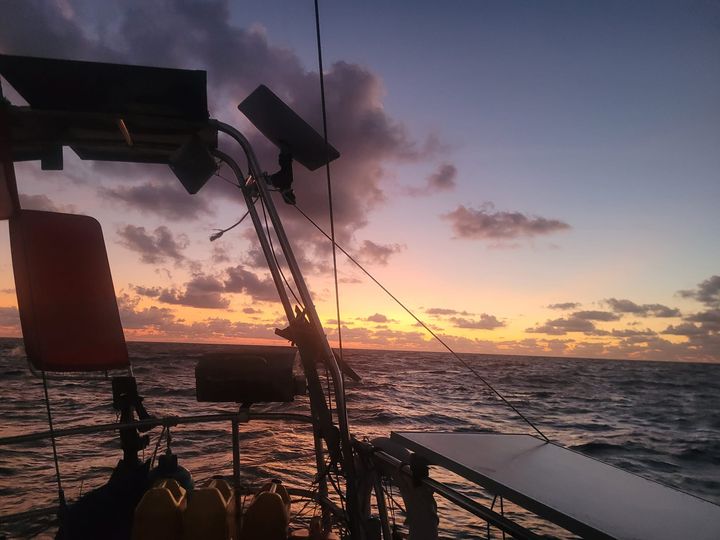
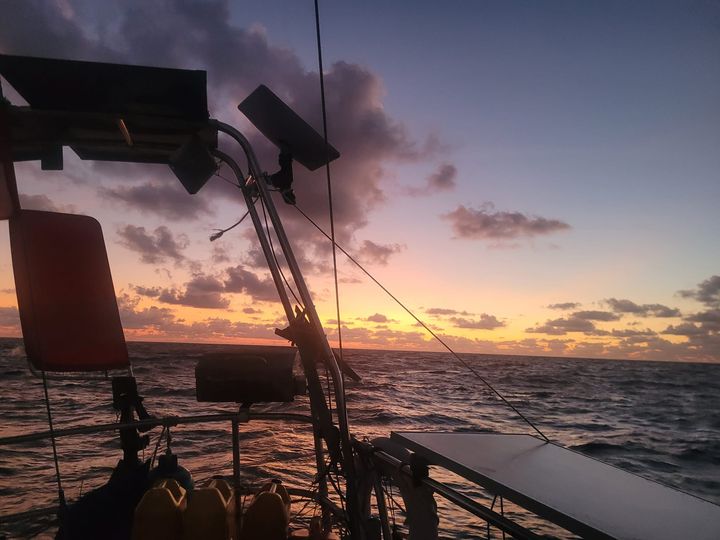
Sunsets are lovely
And then came the morning when I was just getting to bed for my final sleep shift and Owen called for me to get on deck “NOW!”. I rushed up on deck only to find our Hydrovane waving around wildly on the back of the boat. For those who do not know, our Hydrovane is a self-steering vane that attaches to the stern of our boat by two brackets – it has a vane that catches the wind to determine which direction to go, and its own rudder that steers the boat based on feedback from the vane. It is our invaluable third crew member – steering the boat while we daydream, or get lunch, or go to the washroom or read – as long as we are keeping an eye out for other boats or obstacles, we don’t need to drive – our Hydrovane does it for us. Now, our hydrovane was apparently as frustrated with the conditions as were and was trying to jump ship!!! The nuts for the bottom bracket had backed out allowing the entire bracket to pull away from the boat. The top bracket has a tube of stainless steel inserted into it that acts as a “stand off”, keeping the hydrovane straight even though our stern is not. The entire unit was basically twisting around on this tube. This was an “us” issue, not a hydrovane issue – Owen used lock washers and apparently they just backed themselves off the bolts. After about three hours, we managed to wrangle the unit into a steady upright position by tying spinnaker sheets around the head unit and taking those back to winches. Owen was able to push the bolts back into their holes using a dinghy paddle and then he had to climb under our bed to get new nuts on them. Unfortunately, in all of the chaos we lost a shaper block – a piece of starboard that had been used to stand the bracket off the stern. Once he got the bolts back in, we needed to drop the rudder and get it on board which we finally did. After three hours we had saved the unit, but we were going to be hand steering until we could fashion a new shaper block and until we had conditions that would allow us to get it and the rudder reinstalled.
At this time, we were approaching the dreaded ITCZ – the intertropical convergence zone – the point north of the equator where the northern and southern weather systems clash, leading to wild, squally weather. I had already been dreading this area, but now, knowing we would be hand steering through it, I was terrified. I actually insisted at that point that we should turn the boat north and plot a course back to Canada – that is how much I did not want to hand steer through the ITCZ!!!
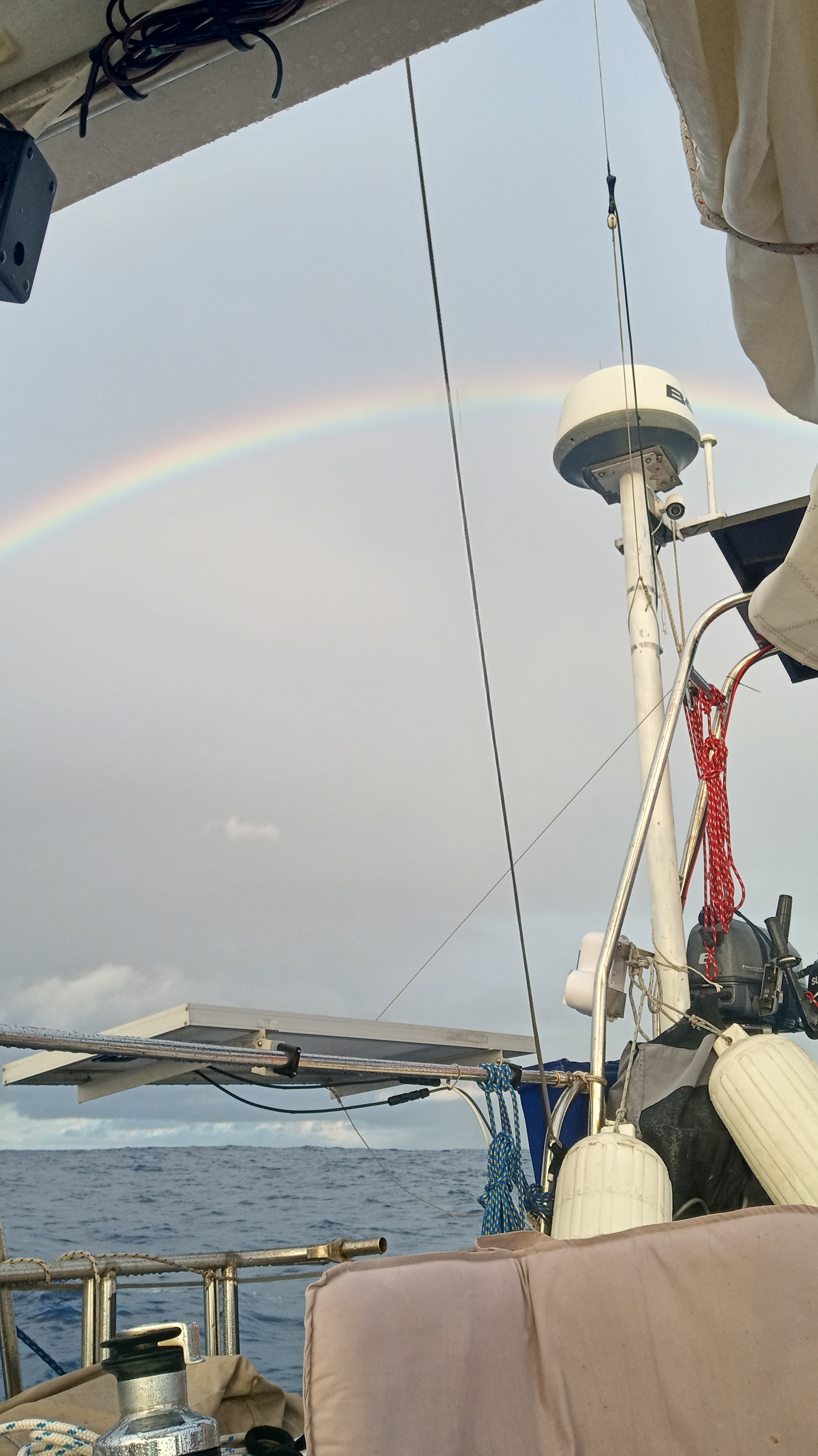
For the next several days we hand steered in three hour shifts at night and two hour shifts during the day – by the end of day one my shoulder was aching from driving from the side. The conditions had not mellowed and keeping the boat heading in some sort of steady position in those conditions was a workout!! And then they started – the squalls. The first one hit me on a night shift – the wind suddenly picked up for a few minutes and then it rained – and rained – and rained!! For about half an hour it absolutely poured – and then, as fast as it started, the rain stopped – as did the wind. I bobbed around for about fifteen minutes until slowly the wind returned to the speed it had been before the squall and we were off again. Owen had a similar squall on his next shift and we were very smugly thinking we had these things figured out. Little did we know. A couple of days into the ITCZ, when we were fully exhausted from hand steering, we hit our biggest squall. Owen was just handing the boat over to me for my shift when the wind increased from the steady 12-15 it had been all night to 28 knots – all within about 4 minutes. Within minutes we were being rounded up constantly and I could no longer handle the wheel alone. Owen came back on deck to help with the steering and it was about then the rain started. Rain in volumes that made me wonder if you could drown while sitting in the cockpit, rain that was driving in so hard it literally stripped the paint from one side of our mast. We turned on the radar and could see the system was huge. We kept trying to drive around the bottom of it – hoping it would continue on above us but it just kept forming and reforming around us. For over two hours we struggled through giant seas, driving rain and 28 – 34 knot winds. We were both exhausted and not a little terrified. When it was finally over, and the sky started to clear, I still had to hand steer for another three hours – I was just about losing my mind at this point!!!
We were making very big plans for once we got out of the ITCZ – where once the doldrums were a dreaded turn of phrase, we were hoping for some flat calm conditions. Our plan was that once we did get into those flat calm conditions, we would inflate my paddle board and then we could use that to easier access the lower bracket and to reinstall the rudder. The squalls continued, but the doldrums did not arrive. Finally, our router advised that we had cleared the worst of the weather and were unlikely to see any further big squalls. The seas were still huge but the wind had died down substantially. We had been hand steering for about 4 and a half days at this point and the novelty had quickly worn off!!! Owen decided we had to figure out a way to get everything reinstalled while the winds were at least calm. Launching the paddle board was not an option – the seas were too big. Instead, Owen put on his tether and leaned way out over the back of the boat, with me holding onto his legs. Luckily, we had some wood on board that he was able to fashion into a shaper block and with some monumental gymnastics on his part, he was able to get one bolt out, move the shaper block in, push the bolt back in, go below to put a nut on it and then repeat with the second side. We then attached a wrench to a stick so I could lean out over the back and hold the bolts firm while he tightened the nuts from below. A couple of hours later we finally had the bracket soundly reinstalled. Now it was time for the rudder. The rudder needs to be pushed into the water and then lifted up onto the shaft where it is secured by a pin. That pin is then secured by an additional cotter-pin to be sure it does not slide out. We finally decided the best course of action to achieve this was to hang our boarding ladder off the back rail – this put the ladder further out of the water than it usually is but gave Owen access down the stern. He put his climbing harness on and we attached him to the outboard lifting pulley. He climbed down to the bottom rung, kneeled on it and managed to reach down to get the rudder pushed onto the shaft – easy peasy!! Now of course he needed to get the pin in – he tried to do it one-handed but realized he would need both hands – as soon as he let go of the ladder he Peter Panned out the side of the boat – hanging from his harness. He got back onto the ladder and climbed up for a rethink. I sat on the back holding onto the rope that was attached to the rudder, being sure it did not slip back off the shaft. We finally decided to add a second line that I would pull around to mid-ships to keep him from flying off to the side of the boat. He headed back down and after a few dunks in the 30 degree ocean water he finally had the pin and the cotter pin in place. We attached the vane, set the course and just like that we were no longer hand steering!! It was such a relief to be able to sit back and let it do its job!! We were of course on high alert for the next several days – double and triple checking all the bolts were secure multiple times a day!!!
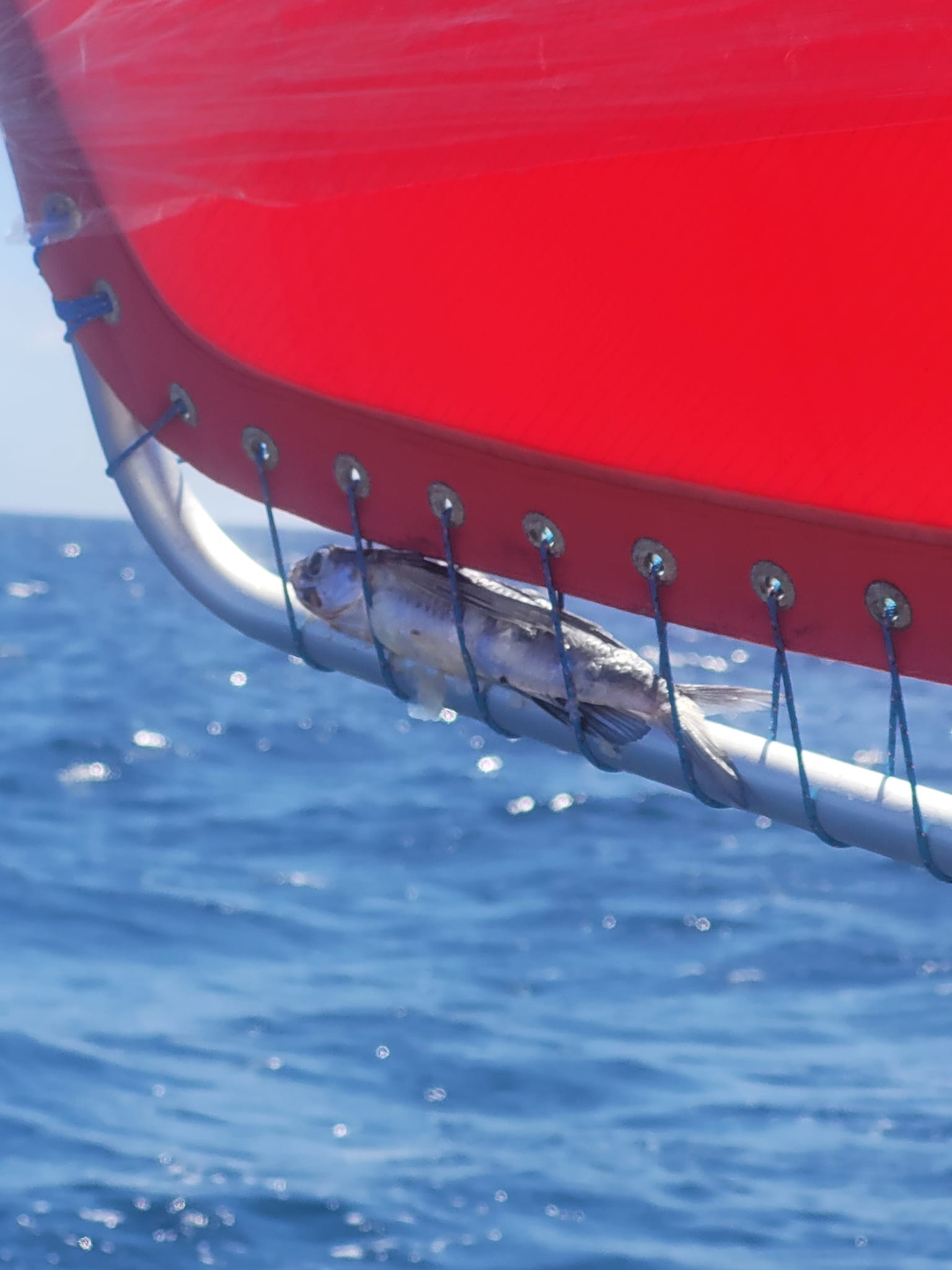
Just the next night, as I was happily playing solitaire on my phone instead of hand-steering through my first night shift I suddenly got whacked in the face – hard and out of nowhere!! I had no idea what had happened until I felt and heard the fish flopping around in my lap. I screamed – loudly – and flew to the opposite corner of the cockpit. When Owen rushed on deck – probably figuring our mast was coming down or the hydrovane was coming off again, he found me crouched in the corner, clutching my face and saying repeatedly “flying fish in the face, flying fish in the face”! Sure enough, when Owen got out a flashlight and panned it around, there was a flying fish still flopping around where I had been sitting moments ago. Owen dispatched it back to the sea and, after a good laugh at my expense, went back to sleep. I went below the scrape the skin right off of my face!!!
This is not the culprit that smacked me in the face – this one somehow managed to wedge itself right into our Hydrovane – ignore the tape on the vane!
One of the other problems that had been plaguing us since the ITCZ had been a plugged holding tank vent. Because the vent was plugged, every time we flushed the head, the gases would vent into our cabin through a not quite sealed inspection vent – the boat stank and I spent an inordinate amount of time gagging over the smell. Very often, when it is plugged it means that water has gotten in the vent – it is near the waterline at the stern so it is not unlikely for it to happen. The solution is to put the vacuum cleaner into “blow” mode and to put it in the pump out fitting on deck – this pushes the water out and everything is back to normal. If it is “something else” plugging the vent however, the air from the vacuum will create a back-pressure situation. We figured it was just water – we had, after all, just come out of some gnarly seas. So, I went out to the stern of the boat so that I could watch to be sure the water was clearing and Owen put the vacuum into the fitting. No water came out – we should have stopped there. But no, of course we did not. Instead, Owen turned the vacuum back on and sure enough the pressure built up until a geyser of pooh-water came fountaining out of the fitting – Owen jumped back out of the way but the wind kindly took the entire geyser and sent it flying to the back of the boat – covering the deck, some cushions and me. And then, just for good measure, it happened a second time. I couldn’t safely maneuver back to the cockpit as the deck was covered in gross slime and I couldn’t just jump over board as we were underway in pretty big seas, so I had to stand there while Owen bucket washed between him and me, finally allowing me to dive into the shower, with my clothes still on!
Were we having fun at this point? I think I was actually questioning all of my life decisions that led to us being out in the middle of the Pacific Ocean – we were certainly not having the downwind sleigh ride that everyone had promised us. More often than not the wind was forward of our beam and we were hard on our ear. Trying to do anything down below was difficult and we had a few cheese and cracker or granola bars meals. We did manage a few really good meals – I finally got smart enough to get whatever I could get prepped during the early afternoon when the winds were inevitably a little calmer, so that I didn’t have to be below for longer than necessary when the winds picked up (always just as I was starting to cook dinner!). We did of course have some amazing sunsets and sunrises and the stars at night were amazing. It was such a surreal experience to realize that I was using the Southern Cross to drive by. We saw quite a few dolphins, a tuna jumping out of the water (chasing something? Being chased?) and the flying fish were everywhere. We didn’t see any whales after we left Mexico (though after our friends collided with a mama whale and her calf (thankfully not causing major damage to either the boat or the whales!), I stopped hoping to see them!). I had hoped to encounter some sea turtles but sadly didn’t see any of them either.
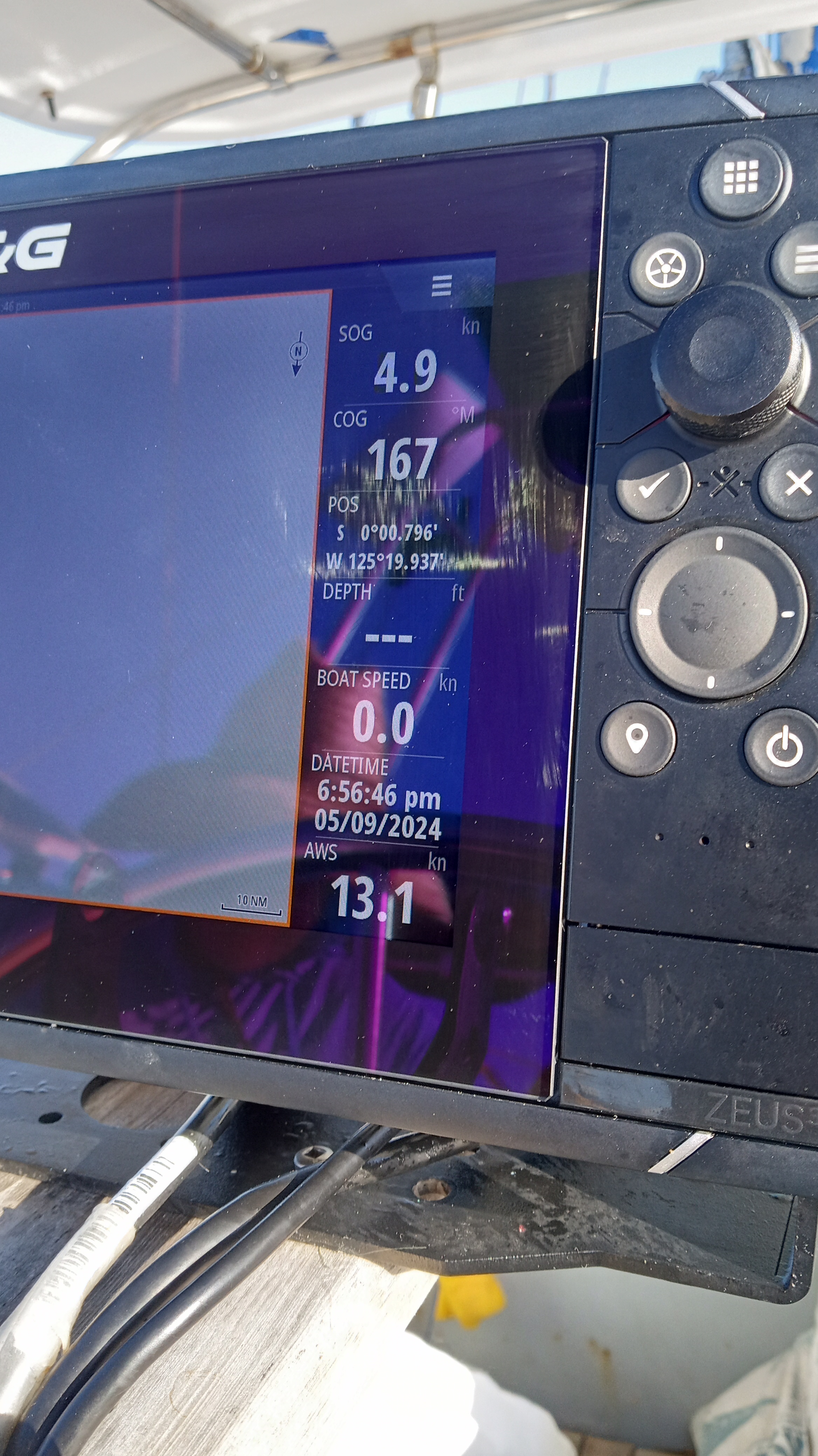
On May 10 we finally crossed the equator – we did our little ceremony, asking Neptune for permission to cross and offering him some rum. We are pollywogs no more – we can now call ourselves Shellbacks! The conditions the day before had been sufficiently calm that I was able to bake some cupcakes so we celebrated our success with chocolate cupcakes and then started to count down to our arrival in the Marquesas. We had a few nice, settled days of almost downwind sailing and then again were sailing hard on the wind. We were thankfully making pretty good mileage, averaging a little over a 100 miles a day at this point.
Finally across the equators – we are Shellbacks!About 400 miles from the Marquesas – the sunsets were stunning!
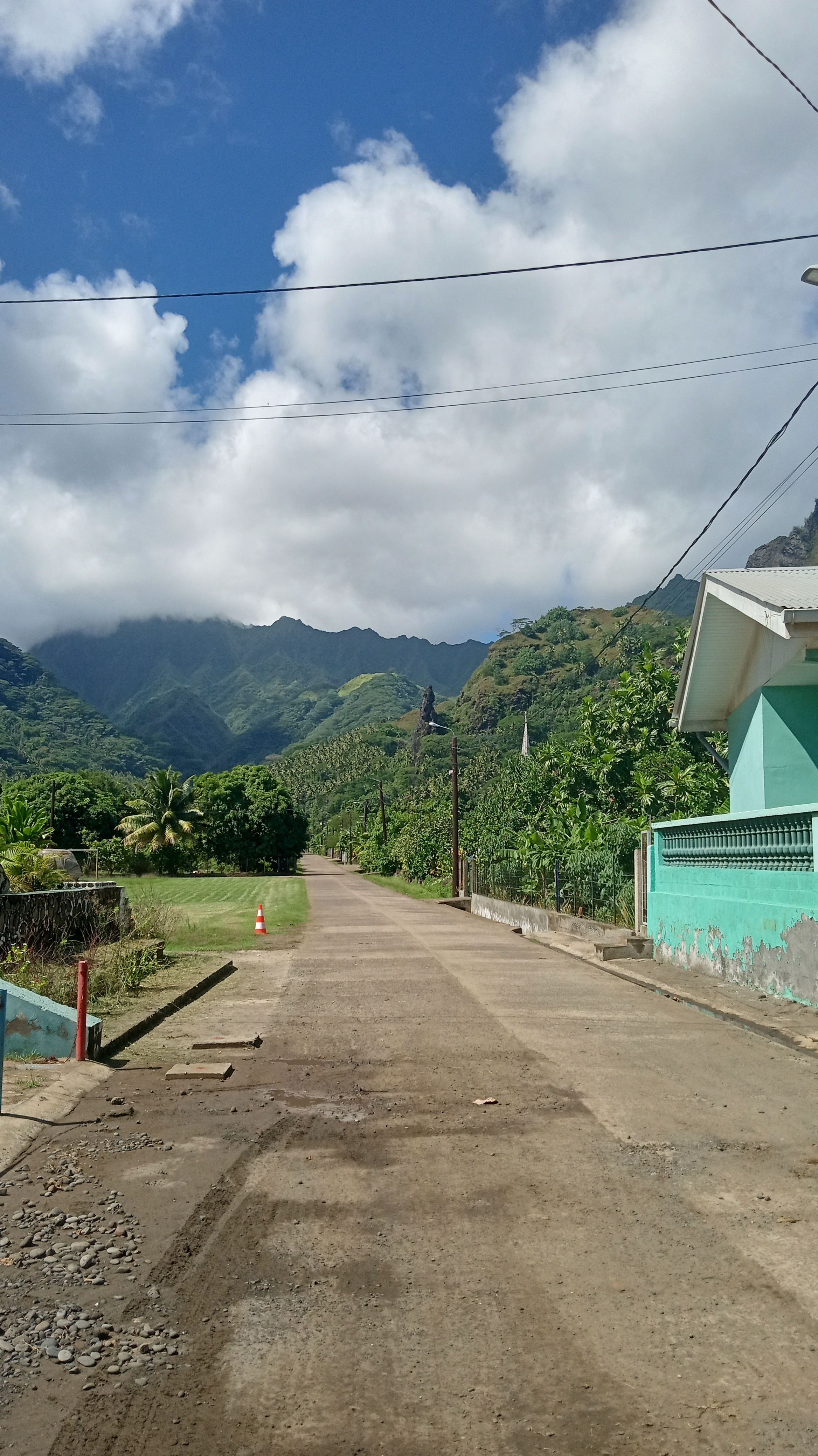
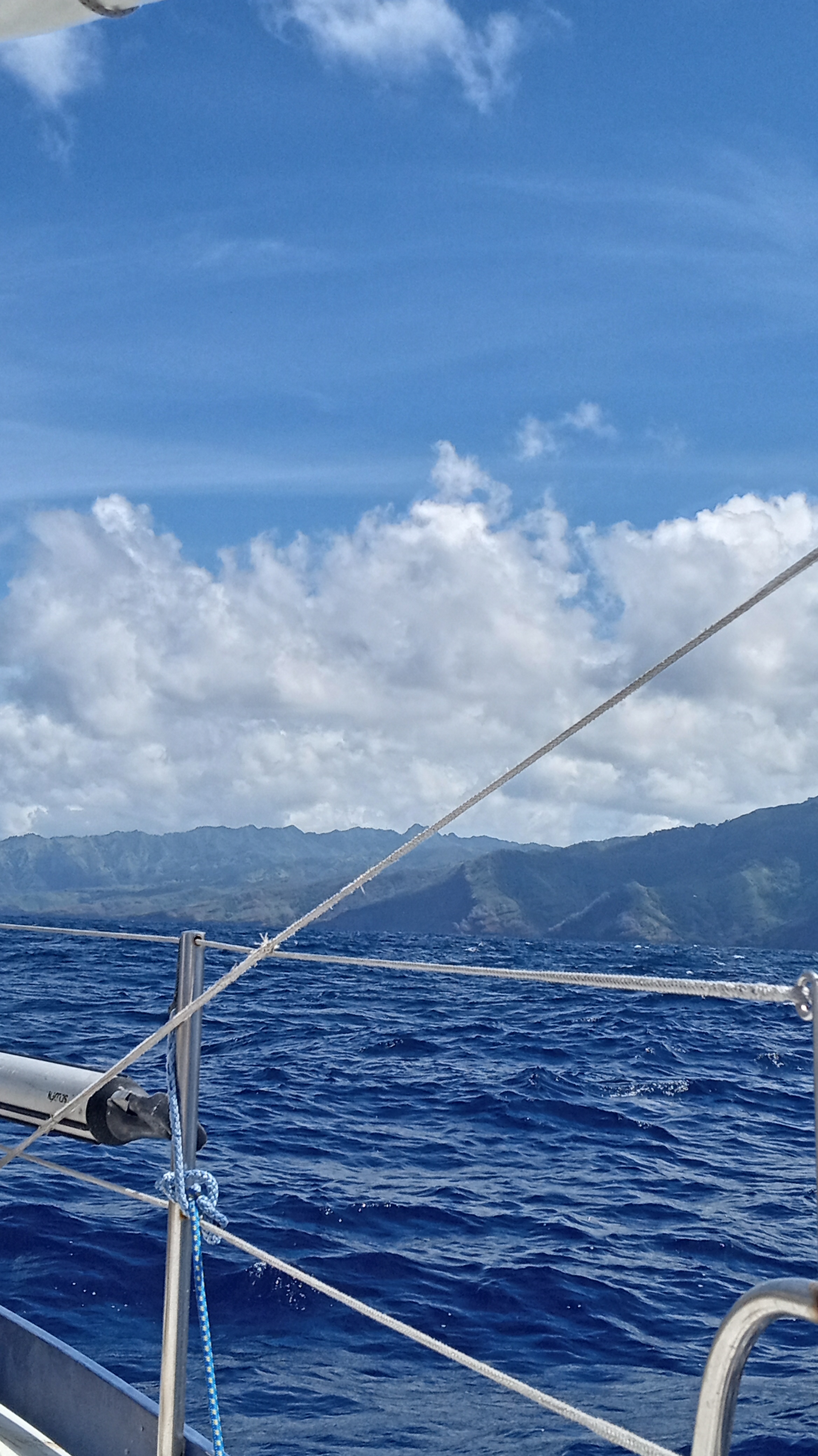
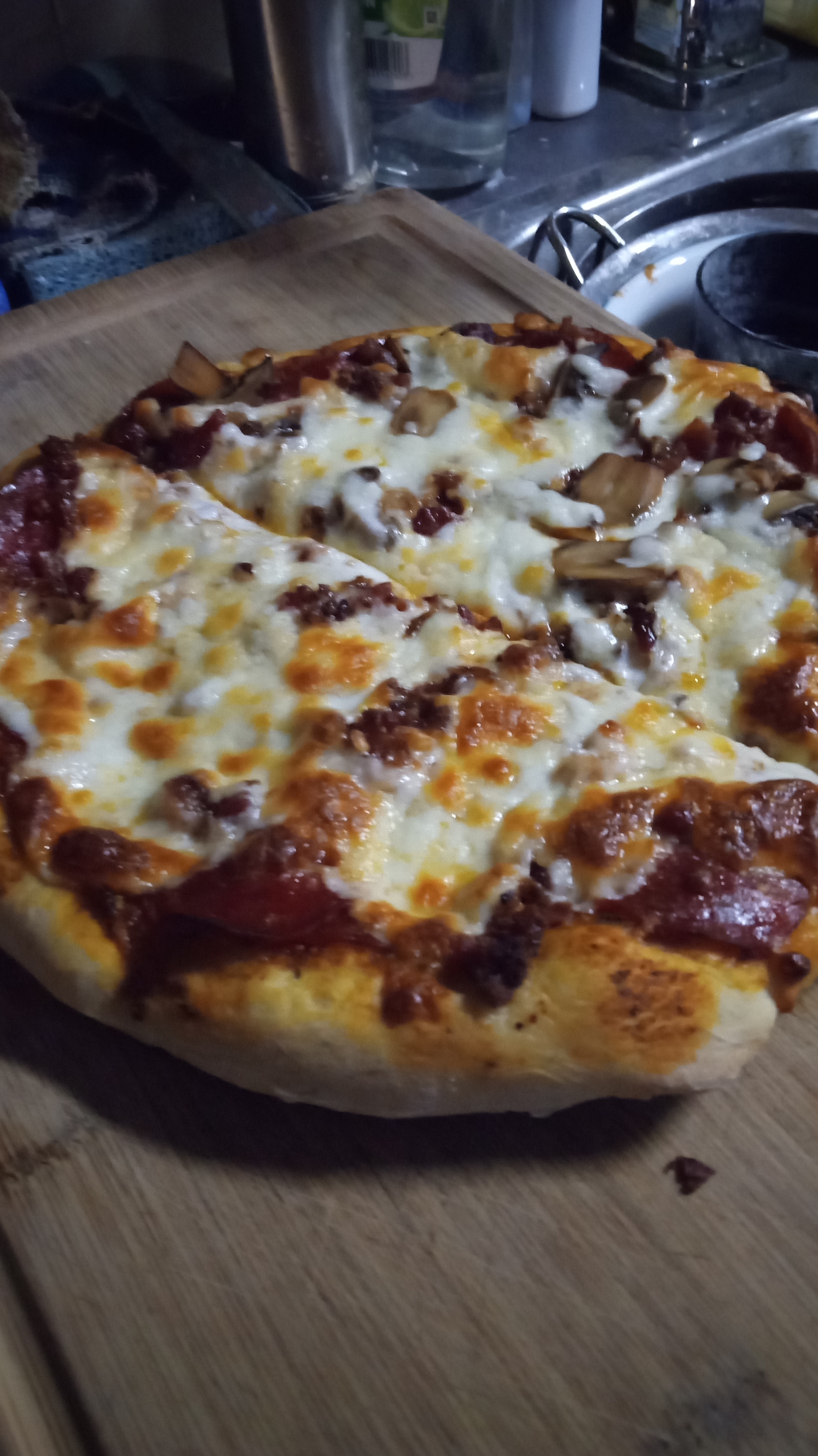
On May 19, 35 days and 1 hour after leaving La Cruz, we finally dropped our anchor at Atuona on the Island of Hiva Oa. We had made it and wow was it a place to be. It was so lush and smelled so good! Unfortunately, it was also a very rolly anchorage – the inner harbour was full so we bobbed and rolled around outside. We arrived on the Sunday of a long weekend and we were unable to check in until Tuesday. I am not sure I was entirely upset about that – it gave us the time to get some rest and get some stuff cleaned up before we tackled reinflating the dinghy on the rolly deck. We were able to enjoy pizza on the boat and (try to) sleep for 7 uninterrupted hours – in our own bed! On the Tuesday we were up early and walked the nearly two miles into town – with a steep hill thrown in for good measure. After having not walked on land for 37 days, I am sure we looked drunk, staggering a little as the ground failed to come up to meet us as we walked!! The check in procedure was short and sweet and soon we were exploring the little town – we found the “bakery” – which was actually a counter at a small grocery store – but it had cold drinks and pain du chocolate so we were happy! By the time we got back to the boat we had covered nearly 10km on feet that had not been on ground in over a month – we were exhausted!
LandfallThe Atuona anchorage is not very comfortable – but it sure is pretty!
We had realized part way across that our batteries would need to be replaced and we tried to find somewhere to do that in Atoana but they will have to be ordered from Tahiti and shipped in and that is a work in progress. Finally, after four rolly nights in the anchorage where I had barely been able to get any sleep for fear of falling out of bed, we got one load of fuel, a few groceries and decamped to Tahuata, the island immediately to the south of Hiva Oa. What a difference! We dropped anchor in crystal clear water and gently bobbed around in this gorgeous anchorage. I spent the first day doing bucket loads of laundry and popping in and out of the warm, clear, calm water. I spent more time in the water on this first day than I had in the entire last season in Mexico. This – this is why we crossed an ocean!!!
And so, as I hoped, I can tell you we did it. We made it from Mexico to the Marquesas, with some drama and less than ideal sailing conditions – but we made it. We are here and now we can start to explore!!


















 tjsailing