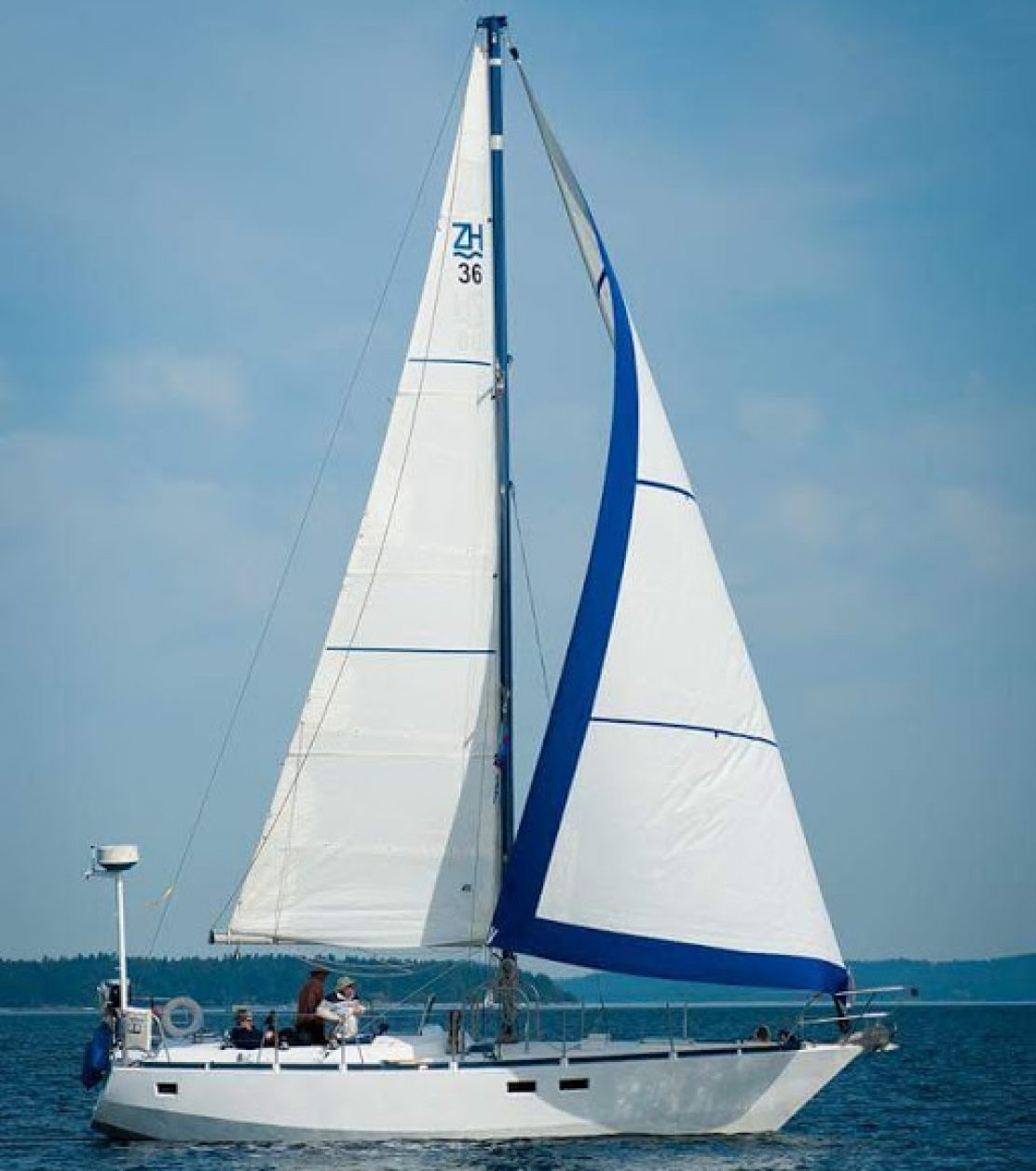

As we headed out from Clarion Island, intent on heading to the magic 10N-120W position, we were joined by one of the boats that had been anchored with us. We hoped to be able to sail in proximity to them for a few days but almost immediately those plans changed – we received a message from our router instructing that, rather than angling down to 10-120, we should sail due west to 120 and then sail South to 10N. Dakota, meanwhile, headed off on an angle (and arrived in the Marquesas 3 or 4 days ahead of us.)
Unfortunately trying to sail due west put us in very confused seas – we were sailing nearly dead downwind – not a fast point of sail for us and being tossed around relentlessly. We were taking waves from at least three directions with many of those breaking into the cockpit – and one of those going straight down the hatch, setting off the propane sensor alarm as it got doused in sea water. Everything was wet! I was very seriously wondering why we wanted to do this on more than a few occasions. We plodded our way slowly out to 120 W and finally were able to turn south – and again, the conditions were terrible. Almost immediately we were struggling through giant beam seas – rolling rail to rail and being tossed around with every roll. The going was not what one might call good!
And so we continued south, slowly and somewhat violently. We had warned our router that we were not a fast boat – I don’t think he understood how not fast we were until he was watching our very slow progress. There were days that we were barely making 60 miles a day – given the 3000 miles that we had to cover, this felt a little painfully slow!

And then came the morning when I was just getting to bed for my final sleep shift and Owen called for me to get on deck “NOW!”. I rushed up on deck only to find our Hydrovane waving around wildly on the back of the boat. For those who do not know, our Hydrovane is a self-steering vane that attaches to the stern of our boat by two brackets – it has a vane that catches the wind to determine which direction to go, and its own rudder that steers the boat based on feedback from the vane. It is our invaluable third crew member – steering the boat while we daydream, or get lunch, or go to the washroom or read – as long as we are keeping an eye out for other boats or obstacles, we don’t need to drive – our Hydrovane does it for us. Now, our hydrovane was apparently as frustrated with the conditions as were and was trying to jump ship!!! The nuts for the bottom bracket had backed out allowing the entire bracket to pull away from the boat. The top bracket has a tube of stainless steel inserted into it that acts as a “stand off”, keeping the hydrovane straight even though our stern is not. The entire unit was basically twisting around on this tube. This was an “us” issue, not a hydrovane issue – Owen used lock washers and apparently they just backed themselves off the bolts. After about three hours, we managed to wrangle the unit into a steady upright position by tying spinnaker sheets around the head unit and taking those back to winches. Owen was able to push the bolts back into their holes using a dinghy paddle and then he had to climb under our bed to get new nuts on them. Unfortunately, in all of the chaos we lost a shaper block – a piece of starboard that had been used to stand the bracket off the stern. Once he got the bolts back in, we needed to drop the rudder and get it on board which we finally did. After three hours we had saved the unit, but we were going to be hand steering until we could fashion a new shaper block and until we had conditions that would allow us to get it and the rudder reinstalled.
At this time, we were approaching the dreaded ITCZ – the intertropical convergence zone – the point north of the equator where the northern and southern weather systems clash, leading to wild, squally weather. I had already been dreading this area, but now, knowing we would be hand steering through it, I was terrified. I actually insisted at that point that we should turn the boat north and plot a course back to Canada – that is how much I did not want to hand steer through the ITCZ!!!
For the next several days we hand steered in three hour shifts at night and two hour shifts during the day – by the end of day one my shoulder was aching from driving from the side. The conditions had not mellowed and keeping the boat heading in some sort of steady position in those conditions was a workout!! And then they started – the squalls. The first one hit me on a night shift – the wind suddenly picked up for a few minutes and then it rained – and rained – and rained!! For about half an hour it absolutely poured – and then, as fast as it started, the rain stopped – as did the wind. I bobbed around for about fifteen minutes until slowly the wind returned to the speed it had been before the squall and we were off again. Owen had a similar squall on his next shift and we were very smugly thinking we had these things figured out. Little did we know. A couple of days into the ITCZ, when we were fully exhausted from hand steering, we hit our biggest squall. Owen was just handing the boat over to me for my shift when the wind increased from the steady 12-15 it had been all night to 28 knots – all within about 4 minutes. Within minutes we were being rounded up constantly and I could no longer handle the wheel alone. Owen came back on deck to help with the steering and it was about then the rain started. Rain in volumes that made me wonder if you could drown while sitting in the cockpit, rain that was driving in so hard it literally stripped the paint from one side of our mast. We turned on the radar and could see the system was huge. We kept trying to drive around the bottom of it – hoping it would continue on above us but it just kept forming and reforming around us. For over two hours we struggled through giant seas, driving rain and 28 – 34 knot winds. We were both exhausted and not a little terrified. When it was finally over, and the sky started to clear, I still had to hand steer for another three hours – I was just about losing my mind at this point!!!
We were making very big plans for once we got out of the ITCZ – where once the doldrums were a dreaded turn of phrase, we were hoping for some flat calm conditions. Our plan was that once we did get into those flat calm conditions, we would inflate my paddle board and then we could use that to easier access the lower bracket and to reinstall the rudder. The squalls continued, but the doldrums did not arrive. Finally, our router advised that we had cleared the worst of the weather and were unlikely to see any further big squalls. The seas were still huge but the wind had died down substantially. We had been hand steering for about 4 and a half days at this point and the novelty had quickly worn off!!! Owen decided we had to figure out a way to get everything reinstalled while the winds were at least calm. Launching the paddle board was not an option – the seas were too big. Instead, Owen put on his tether and leaned way out over the back of the boat, with me holding onto his legs. Luckily, we had some wood on board that he was able to fashion into a shaper block and with some monumental gymnastics on his part, he was able to get one bolt out, move the shaper block in, push the bolt back in, go below to put a nut on it and then repeat with the second side. We then attached a wrench to a stick so I could lean out over the back and hold the bolts firm while he tightened the nuts from below. A couple of hours later we finally had the bracket soundly reinstalled. Now it was time for the rudder. The rudder needs to be pushed into the water and then lifted up onto the shaft where it is secured by a pin. That pin is then secured by an additional cotter-pin to be sure it does not slide out. We finally decided the best course of action to achieve this was to hang our boarding ladder off the back rail – this put the ladder further out of the water than it usually is but gave Owen access down the stern. He put his climbing harness on and we attached him to the outboard lifting pulley. He climbed down to the bottom rung, kneeled on it and managed to reach down to get the rudder pushed onto the shaft – easy peasy!! Now of course he needed to get the pin in – he tried to do it one-handed but realized he would need both hands – as soon as he let go of the ladder he Peter Panned out the side of the boat – hanging from his harness. He got back onto the ladder and climbed up for a rethink. I sat on the back holding onto the rope that was attached to the rudder, being sure it did not slip back off the shaft. We finally decided to add a second line that I would pull around to mid-ships to keep him from flying off to the side of the boat. He headed back down and after a few dunks in the 30 degree ocean water he finally had the pin and the cotter pin in place. We attached the vane, set the course and just like that we were no longer hand steering!! It was such a relief to be able to sit back and let it do its job!! We were of course on high alert for the next several days – double and triple checking all the bolts were secure multiple times a day!!!
Just the next night, as I was happily playing solitaire on my phone instead of hand-steering through my first night shift I suddenly got whacked in the face – hard and out of nowhere!! I had no idea what had happened until I felt and heard the fish flopping around in my lap. I screamed – loudly – and flew to the opposite corner of the cockpit. When Owen rushed on deck – probably figuring our mast was coming down or the hydrovane was coming off again, he found me crouched in the corner, clutching my face and saying repeatedly “flying fish in the face, flying fish in the face”! Sure enough, when Owen got out a flashlight and panned it around, there was a flying fish still flopping around where I had been sitting moments ago. Owen dispatched it back to the sea and, after a good laugh at my expense, went back to sleep. I went below the scrape the skin right off of my face!!!

One of the other problems that had been plaguing us since the ITCZ had been a plugged holding tank vent. Because the vent was plugged, every time we flushed the head, the gases would vent into our cabin through a not quite sealed inspection vent – the boat stank and I spent an inordinate amount of time gagging over the smell. Very often, when it is plugged it means that water has gotten in the vent – it is near the waterline at the stern so it is not unlikely for it to happen. The solution is to put the vacuum cleaner into “blow” mode and to put it in the pump out fitting on deck – this pushes the water out and everything is back to normal. If it is “something else” plugging the vent however, the air from the vacuum will create a back-pressure situation. We figured it was just water – we had, after all, just come out of some gnarly seas. So, I went out to the stern of the boat so that I could watch to be sure the water was clearing and Owen put the vacuum into the fitting. No water came out – we should have stopped there. But no, of course we did not. Instead, Owen turned the vacuum back on and sure enough the pressure built up until a geyser of pooh-water came fountaining out of the fitting – Owen jumped back out of the way but the wind kindly took the entire geyser and sent it flying to the back of the boat – covering the deck, some cushions and me. And then, just for good measure, it happened a second time. I couldn’t safely maneuver back to the cockpit as the deck was covered in gross slime and I couldn’t just jump over board as we were underway in pretty big seas, so I had to stand there while Owen bucket washed between him and me, finally allowing me to dive into the shower, with my clothes still on!
Were we having fun at this point? I think I was actually questioning all of my life decisions that led to us being out in the middle of the Pacific Ocean – we were certainly not having the downwind sleigh ride that everyone had promised us. More often than not the wind was forward of our beam and we were hard on our ear. Trying to do anything down below was difficult and we had a few cheese and cracker or granola bars meals. We did manage a few really good meals – I finally got smart enough to get whatever I could get prepped during the early afternoon when the winds were inevitably a little calmer, so that I didn’t have to be below for longer than necessary when the winds picked up (always just as I was starting to cook dinner!). We did of course have some amazing sunsets and sunrises and the stars at night were amazing. It was such a surreal experience to realize that I was using the Southern Cross to drive by. We saw quite a few dolphins, a tuna jumping out of the water (chasing something? Being chased?) and the flying fish were everywhere. We didn’t see any whales after we left Mexico (though after our friends collided with a mama whale and her calf (thankfully not causing major damage to either the boat or the whales!), I stopped hoping to see them!). I had hoped to encounter some sea turtles but sadly didn’t see any of them either.
On May 10 we finally crossed the equator – we did our little ceremony, asking Neptune for permission to cross and offering him some rum. We are pollywogs no more – we can now call ourselves Shellbacks! The conditions the day before had been sufficiently calm that I was able to bake some cupcakes so we celebrated our success with chocolate cupcakes and then started to count down to our arrival in the Marquesas. We had a few nice, settled days of almost downwind sailing and then again were sailing hard on the wind. We were thankfully making pretty good mileage, averaging a little over a 100 miles a day at this point.


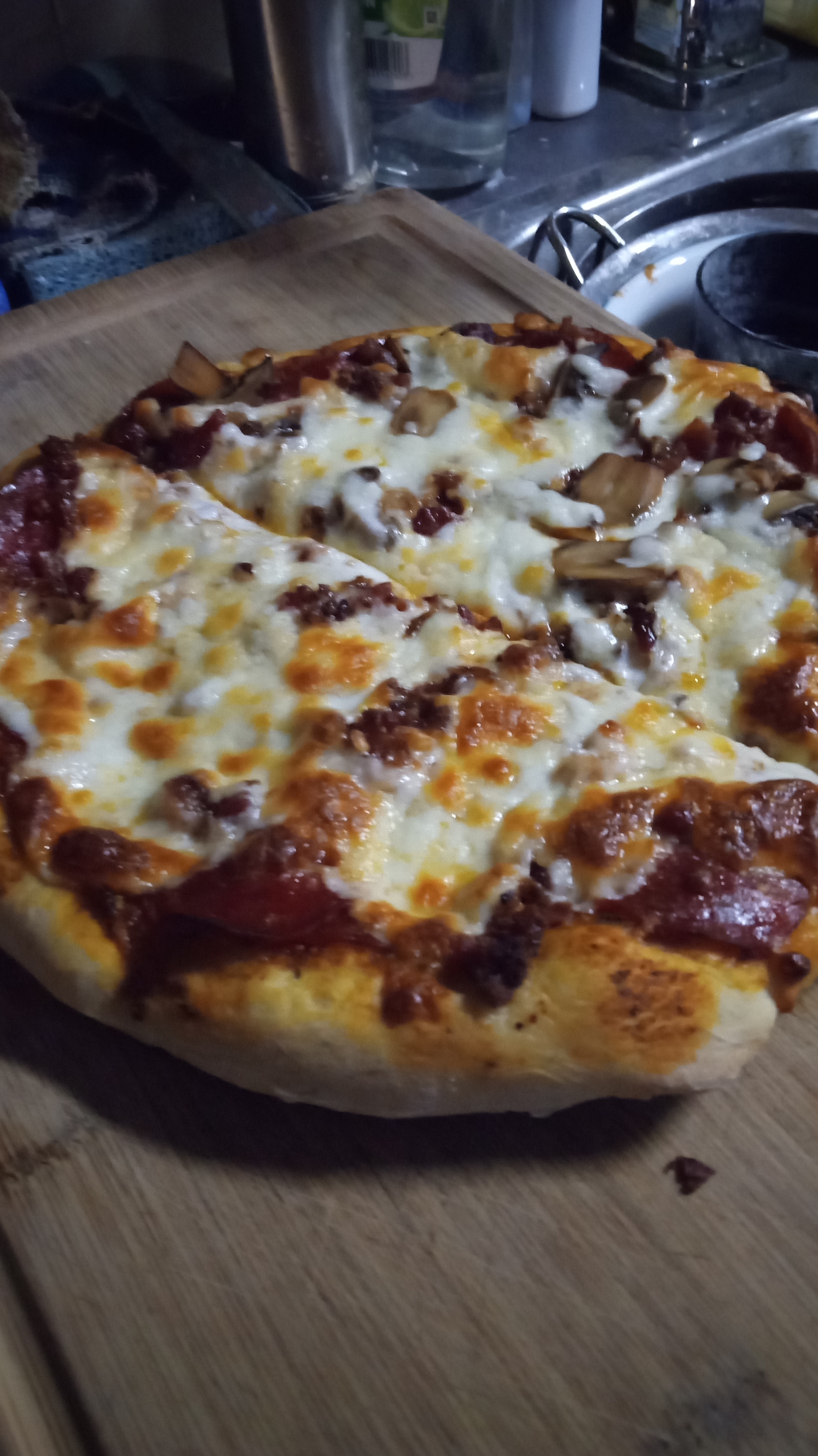
On May 19, 35 days and 1 hour after leaving La Cruz, we finally dropped our anchor at Atuona on the Island of Hiva Oa. We had made it and wow was it a place to be. It was so lush and smelled so good! Unfortunately, it was also a very rolly anchorage – the inner harbour was full so we bobbed and rolled around outside. We arrived on the Sunday of a long weekend and we were unable to check in until Tuesday. I am not sure I was entirely upset about that – it gave us the time to get some rest and get some stuff cleaned up before we tackled reinflating the dinghy on the rolly deck. We were able to enjoy pizza on the boat and (try to) sleep for 7 uninterrupted hours – in our own bed! On the Tuesday we were up early and walked the nearly two miles into town – with a steep hill thrown in for good measure. After having not walked on land for 37 days, I am sure we looked drunk, staggering a little as the ground failed to come up to meet us as we walked!! The check in procedure was short and sweet and soon we were exploring the little town – we found the “bakery” – which was actually a counter at a small grocery store – but it had cold drinks and pain du chocolate so we were happy! By the time we got back to the boat we had covered nearly 10km on feet that had not been on ground in over a month – we were exhausted!
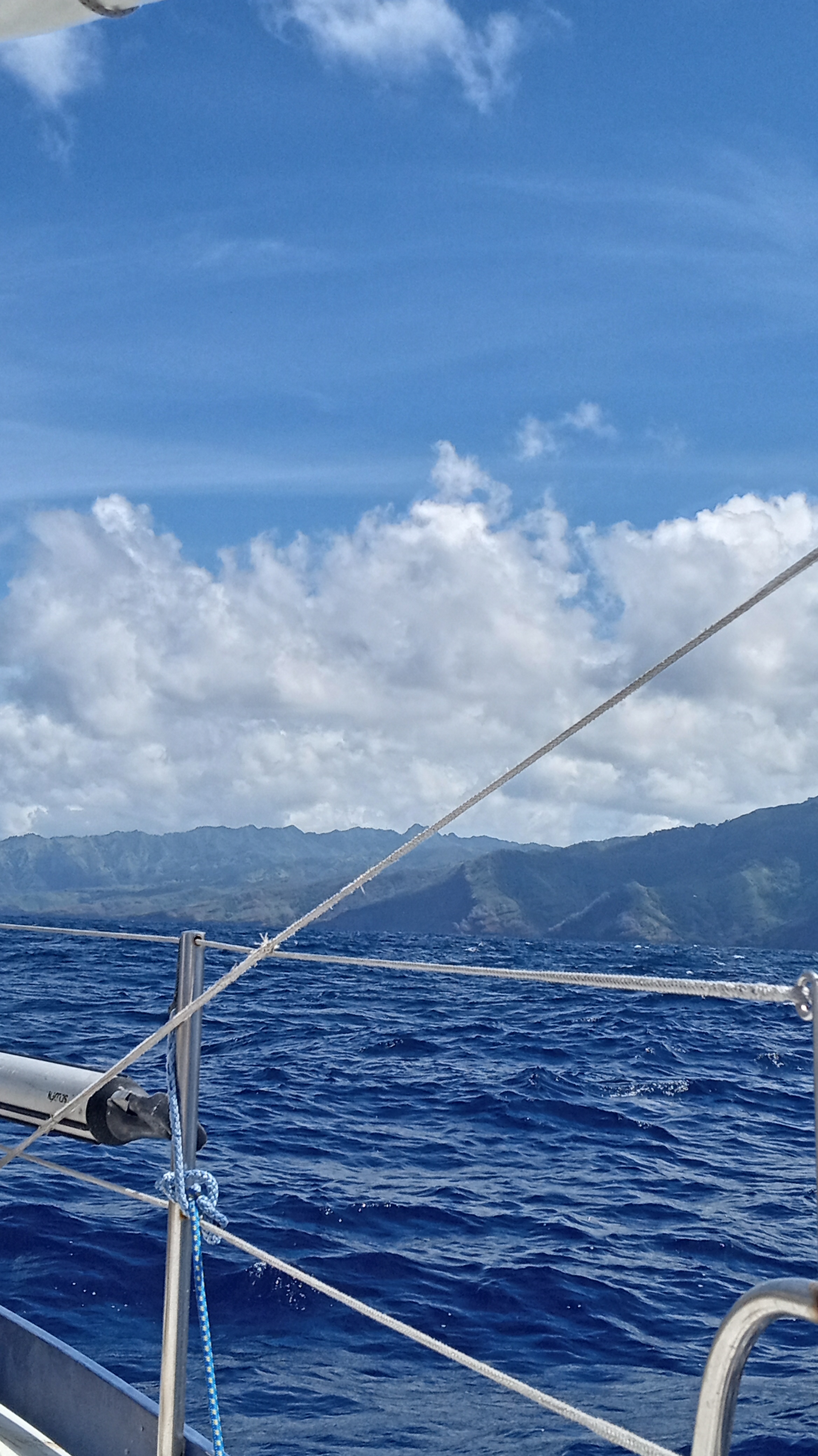

We had realized part way across that our batteries would need to be replaced and we tried to find somewhere to do that in Atoana but they will have to be ordered from Tahiti and shipped in and that is a work in progress. Finally, after four rolly nights in the anchorage where I had barely been able to get any sleep for fear of falling out of bed, we got one load of fuel, a few groceries and decamped to Tahuata, the island immediately to the south of Hiva Oa. What a difference! We dropped anchor in crystal clear water and gently bobbed around in this gorgeous anchorage. I spent the first day doing bucket loads of laundry and popping in and out of the warm, clear, calm water. I spent more time in the water on this first day than I had in the entire last season in Mexico. This – this is why we crossed an ocean!!!
And so, as I hoped, I can tell you we did it. We made it from Mexico to the Marquesas, with some drama and less than ideal sailing conditions – but we made it. We are here and now we can start to explore!!
 tjsailing
Nicely done! Not just a major accomplishment but one with a few extra challenges thrown in for good measure, and you came through with flying colours. Good on ya’s!